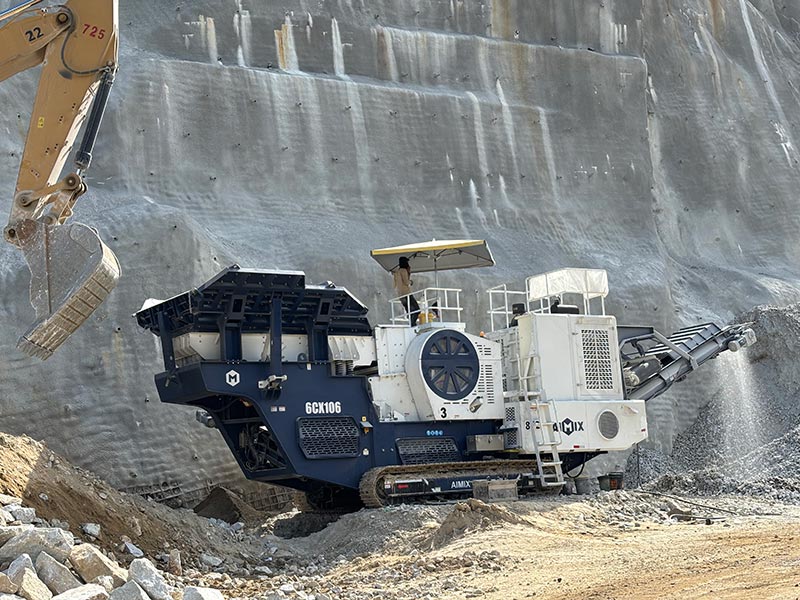
Granite stands as one of the most formidable materials encountered in the aggregate industry, a plutonic rock of immense compressive strength and abrasive tenacity. Subjecting a portable rock crusher to the relentless assault of such an intransigent feedstock demands a rigorous, almost forensic approach to maintenance, particularly concerning the machine’s consumable wear parts. The operational environment is one of ceaseless attrition, where manganese liners, blow bars, and jaw plates are slowly but inexorably consumed by the very material they are designed to fragment. The query, therefore, is not whether these components will fail, but precisely when they should be inspected to preempt catastrophic breakdowns. This article elucidates a systematic inspection regime, delineating the critical timelines and indicators that govern the life cycle of wear components in the harsh context of granite comminution.
1. Understanding the Enemy: Granite’s Abrasive Nature
The fundamental impetus for an aggressive inspection schedule lies in the intrinsic physical characteristics of granite. It is a material that does not yield easily, and its interaction with crusher liners is a primary driver of component degradation.
Granite is replete with quartz and feldspar, minerals possessing a Mohs hardness of 7 and 6, respectively. This high silica content transforms the crusher’s crushing chamber into a grinding mill, where the feed material acts as an abrasive slurry against the steel liners. Furthermore, the rock’s uniaxial compressive strength frequently exceeds 200 MPa, creating immense point loads that exacerbate micro-fracturing on the surfaces of the wear parts. This combination of high hardness and elevated stress dictates that wear rates are accelerated exponentially compared to processing softer, sedimentary rocks like limestone. Consequently, the interval between inspections must be contracted, with vigilance becoming an operational imperative.

The presence of deleterious materials, such as clay or fine sand within the feed, functions as a fugitive lubricant and abrasive agent, accelerating the polishing and gouging of the granite crusher’s manganese. Equally critical is the uniformity of the feed. A surge of oversized boulders inflicts a shock load that can induce stress fractures in the liners, while a cascade of undersized material causes a “cushioning” effect that reduces crushing efficiency but increases sliding abrasion. These heterogeneous feed conditions create localized wear patterns that are notoriously difficult to predict, necessitating a high-frequency visual and dimensional inspection to detect the nascent manifestations of uneven wear.
2. The Quintessential Inspection Protocol
Adhering to a regimented, multi-layered inspection protocol is the only reliable method to safeguard against the financial and operational penalties of a catastrophic liner failure. The process is best categorized by the frequency and the object of scrutiny.
The frontline of defense is the operator’s daily walk-around inspection. This should encompass a visual examination of the crusher feed opening for lodged boulders or visible wear plate deformation. The operator must listen critically for the auditory signatures of a “starved” crusher or conversely, a “choked” condition, each of which imposes aberrant stresses on the wear parts. Checking for spillage under the crusher can reveal a blow-out or a leak in the lower chamber, indicating a breach in the liners. Daily measurements of the closed side setting (CSS) on jaw and cone crushers are not just a performance metric; they serve as an indirect measure of liner depletion, as the setting must be tightened to compensate for wear.
The weekly inspection demands a more thorough undertaking, often requiring a partial shutdown to gain access to the crushing chamber. Utilizing a specialist “wear gauge” or a profile mold, the operator can chart the wear profile of the bowl liner and mantle. These physical measurements must be compared against the “worn out” tolerance lines etched into the casting. Monthly, the comprehensive inspection should include a detailed assessment of the feed chute liners, the impact bars, and the diverter plates, all of which are subject to the erosive forces of falling granite. Documentation of these measurements is paramount, allowing for the projection of wear rates and the forecasting of replacement dates.

3. Recognizing the Signs of End-of-Life Failure
An inspection is only as useful as the inspector’s ability to interpret the data. Identifying the tell-tale harbingers of terminal wear is essential to avoid the peril of a “metal-to-metal” event.
One of the most critical indicators in a cone crusher is the condition of the hydraulic tramp iron relief system. A liner that has worn down to a point where the manganese is less than half its original thickness becomes porous and brittle. This can cause the relief cylinders to fire more frequently, even when tramp metal is not present, as the weakened liner cannot withstand standard crushing forces. Simultaneously, wear plate ejection pins, designed to lift the upper frame, can become sheared or recessed if the liners are allowed to wear down to a point where they interfere with these mechanical interfaces. If these pins are not visible or are bent during inspection, it signals an acute emergency that necessitates immediate liner change-out.
As the manganese liner wears, it eventually exposes the underlying carbon steel mantle or concaves. This phenomenon, known as “burn through,” represents a structural failure of the wear system. Once the carbon steel becomes the primary crushing surface, it will wear with catastrophic speed, potentially damaging the aggregate crusher’s internal bushings and the main shaft. Signs of this on a portable rock crusher include a drastic change in the crusher’s amperage draw, a sudden spike in the hydraulic oil temperature, and the presence of excessive “fines” and metallic particles in the product. An inspection that reveals the surface of the mantle through the worn liner is a terminal diagnosis requiring immediate shut down, as any further operation jeopardizes the crusher’s structural integrity.

Comments
No comments yet. Be the first to react!