Concrete production requirements can vary dramatically between a small residential development and a large highway or industrial project in Nigeria. The difference is not simply the amount of concrete consumed. Project scale also changes the required production capacity, batching frequency, equipment mobility, material storage, transportation arrangements, site space, and degree of automation. A concrete batching plant in Nigeria that works efficiently for a major infrastructure project may be unnecessarily complex for a small contractor, while a compact system may struggle to maintain supply for a high-volume construction program. Understanding this distinction before selecting equipment can prevent both underinvestment and excessive capital expenditure. Small projects generally benefit from flexibility and simple deployment, medium projects need a balance between mobility and output, while large projects usually demand continuous production and substantial aggregate storage. The appropriate concrete production system should therefore evolve with the scale, schedule, and logistical characteristics of the construction work.
How Small and Medium Projects Change Concrete Production Needs
Small Projects Prioritize Flexibility Over Maximum Output
Small residential buildings, farm structures, drainage works, small commercial facilities, and repair projects rarely require continuous high-volume concrete production. Concrete may be needed intermittently, with relatively small quantities consumed during each construction phase. Installing a large stationary batching plant for this type of work can create unnecessary costs. The contractor may need extensive foundations, additional material-handling equipment, larger storage areas, and more operational personnel than the project actually requires. A compact production solution is often more appropriate. The emphasis should be on producing concrete when required, minimizing setup complexity, and maintaining the ability to move equipment when the project location changes.
A Mini Batch Plant Can Match Intermittent Demand
A mini batch plant can be suitable when concrete demand is modest but consistent enough to justify dedicated production equipment. Its smaller footprint can simplify site planning while providing greater control over batching than relying entirely on external ready-mix deliveries. For contractors handling several small projects, the equipment may also be moved between sites, improving asset utilization over time.

Why Overcapacity Can Become a Burden
A plant that is substantially larger than the project’s actual demand does not automatically improve productivity. Excess capacity can remain idle while still generating maintenance, space, power, and capital costs. The better approach is to calculate realistic hourly demand and peak requirements before selecting the plant configuration.
Self-Loading Mixers Offer Another Flexible Option
For highly dispersed projects, a self loading concrete mixer for sale in Nigeria can provide an alternative to a conventional batching setup. A self loading concrete mixer for sale in Nigeria combines aggregate loading, batching or weighing, mixing, and transportation functions in one mobile machine. This arrangement can be particularly useful where concrete is required at several points across a project or where access to commercial ready-mix suppliers is limited. The machine does not need to create a permanent concrete production station. It can move with the construction activity.
Why Larger Nigerian Construction Projects Need Higher Production Capacity
Large Projects Require Continuous and Predictable Supply
Highway construction, major bridges, industrial facilities, airports, large residential developments, and other infrastructure projects can consume concrete at a substantially higher rate. Here, production continuity becomes more important than compactness. A production interruption can affect concrete placement, labor utilization, pumping operations, and the wider construction schedule. A larger concrete plant in Nigeria may therefore require multiple aggregate storage bins, larger cement storage capacity, high-capacity conveyors, automated control systems, and efficient loading arrangements.
Aggregate Storage Becomes a Major Design Consideration
As production volume increases, the plant must store and handle larger quantities of aggregates. Insufficient storage can force frequent replenishment, potentially interrupting batching operations. Large projects therefore need a material supply chain capable of keeping the plant continuously fed.
Production Capacity Must Match Material Supply
There is little benefit in installing a high-capacity mixer if aggregate delivery, cement storage, or water supply cannot support its operating rate. Concrete production should be viewed as an integrated chain: Aggregate supply → Storage → Weighing → Cement and water dosing → Mixing → Concrete delivery → Placement. A bottleneck at any point can limit the effective capacity of the entire system.
Automation Becomes More Valuable at Higher Output
Manual control may be adequate for relatively small operations, but large projects benefit from automated batching and centralized control. Automation can improve dosing consistency, simplify recipe management, record production data, and reduce the likelihood of operator-related variation. For high-volume concrete production, consistency is crucial. The objective is not simply to make concrete faster, but to produce batches with repeatable proportions throughout long operating periods.

How Mobile and Portable Systems Bridge Different Project Scales
Mobile Batching Plants Provide a Middle Ground
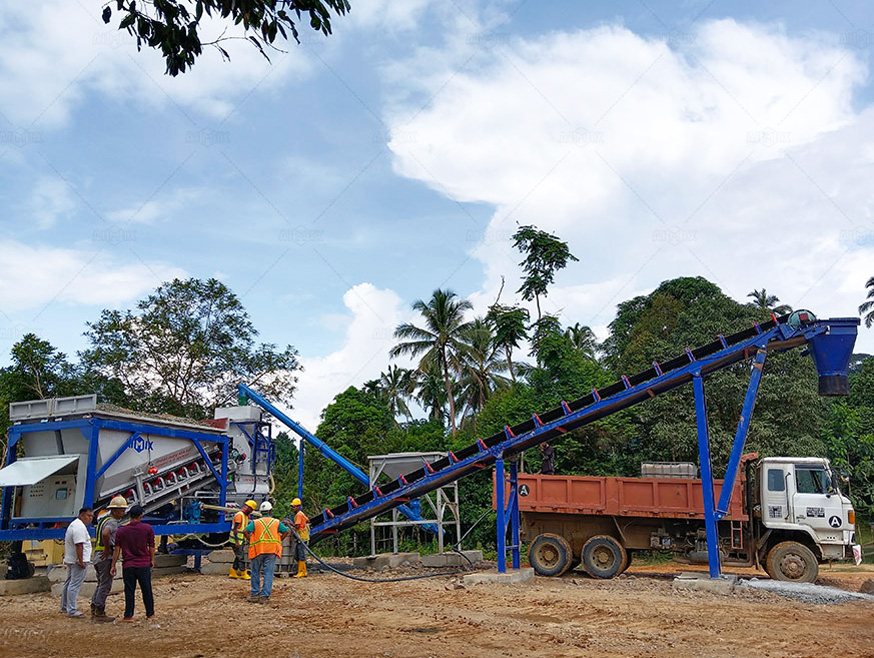
Not every project fits neatly into the categories of small or large. Medium-scale construction often requires more production than a mini system can comfortably provide but does not justify a highly permanent installation. A mobile batching plant can bridge this gap. Its principal advantage is the combination of useful production capacity and improved relocation flexibility. This can benefit contractors working on road projects, residential developments, infrastructure construction, and projects where the active work area changes over time.
Portable Concrete Batch Plants Help Temporary Projects
A portable concrete batch plant can be particularly useful when contractors need dedicated production for a defined construction period without creating a heavily permanent installation. Transportation and installation requirements should still be evaluated carefully. “Portable” does not mean that every configuration can be relocated immediately or without supporting equipment. The practical question is how frequently the plant needs to move and whether its transportation characteristics align with the project’s schedule.
Project Duration Influences Equipment Economics
For a long-term project lasting several years, a stationary plant may justify its installation requirements through sustained production. For a shorter project, a portable or mobile solution may provide better flexibility. Equipment selection should therefore consider both production requirements and the expected life of the installation at each site.
Construction Scale Should Determine the Entire Production Strategy
The most appropriate concrete production solution in Nigeria depends on more than project size. Location, concrete demand, construction duration, road access, available land, material supply, labor availability, and the number of active work fronts all influence the final configuration. A small contractor may find that a mini concrete batch plant or self-loading mixer provides sufficient production with minimal logistical complexity. A medium-scale project may benefit from a mobile batching plant that combines capacity with relocation flexibility. A major infrastructure project may require a high-capacity stationary plant with extensive storage and automated control. The key is proportionality. A concrete plant in Nigeria should be selected according to the actual production pattern rather than an assumed project category. The same principle applies when evaluating a self loading concrete mixer for sale in Nigeria, a mobile batching plant, or a portable concrete batch plant. Ultimately, matching equipment to construction scale allows contractors to avoid two costly extremes: insufficient production that delays construction and excessive equipment capacity that ties up capital without generating proportional value. The most effective concrete supply system is the one that fits the project’s rhythm, geography, and material demand from the first batch to the final pour.
Comments
No comments yet. Be the first to react!