Construction projects in Saudi Arabia are increasingly distributed across large geographic areas, from urban developments and industrial facilities to roads, utilities, tourism infrastructure, and remote construction sites. For contractors working on scattered projects, concrete supply can become a logistical issue long before production capacity becomes a concern. A stationary batching plant may provide high output, but its fixed location can force contractors to depend on long-distance concrete transportation or establish multiple temporary supply points. A mobile concrete plant offers a different model. It brings concrete production closer to the project, allowing contractors to relocate equipment as construction demand shifts. The higher question is therefore not simply whether a mobile concrete plant cost more or less than a stationary alternative, but whether its mobility can reduce the cumulative cost of serving dispersed projects.
Why Scattered Saudi Projects Create Concrete Supply Challenges
Distance Can Turn Concrete Transportation Into a Cost Driver
Concrete is not an ordinary bulk material that can be stored indefinitely before use. Once mixed, it must be transported and placed within an appropriate timeframe to preserve the required workability and performance. For projects located far from a fixed batching plant, transportation can therefore become a significant component of project logistics. Longer routes mean more fuel consumption, greater vehicle utilization, and increased exposure to traffic or access-related delays. Saudi Arabia’s vast geography makes this issue particularly relevant for contractors handling projects across different regions. A fixed plant may be highly efficient when demand is concentrated around one location, but its economic advantage can diminish when concrete must repeatedly travel long distances.
One Fixed Plant May Not Fit Multiple Project Locations
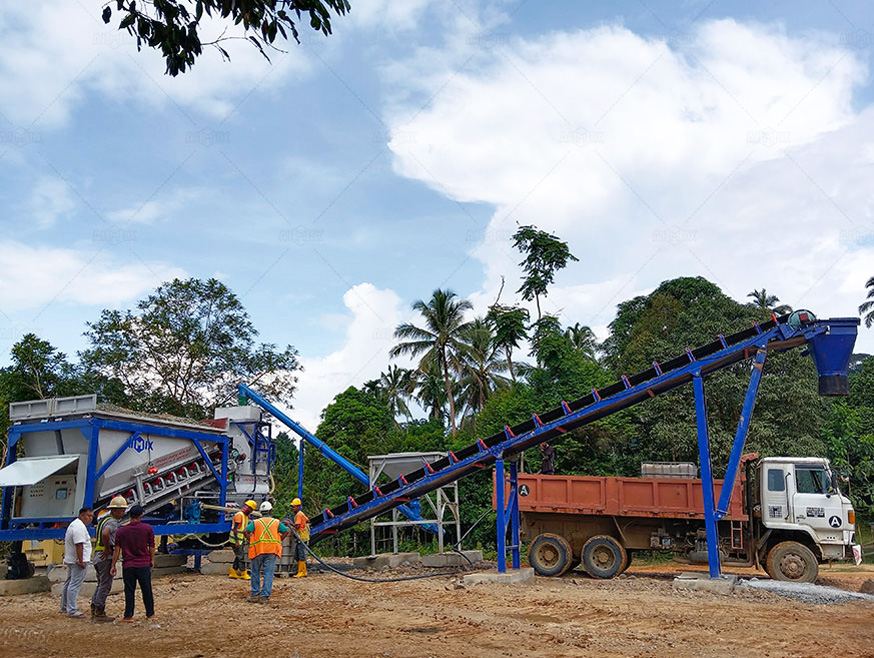
Scattered projects create a different equipment utilization problem. A contractor may simultaneously work on a road section, a remote infrastructure project, and a building development in different locations. Building or leasing a stationary batching facility for every project is rarely practical. Transporting fresh concrete between distant sites is equally inefficient. A mobile concrete plant addresses this spatial mismatch by moving the production capability rather than continuously moving the finished concrete. The distinction is important: transport the plant when necessary, then produce concrete near the point of use.
How a Mobile Concrete Plant Can Offset Its Price
Mobility Creates Value When Projects Move
The primary economic advantage of a mobile equipment is not necessarily a lower purchase mobile batching plant price. It is the ability to use one production system across multiple locations. After completing one project, the plant can potentially be relocated to another site where concrete demand exists. This improves equipment utilization and allows the initial investment to support a broader portfolio of projects. For contractors with recurring work across Saudi Arabia, this flexibility can become a meaningful financial advantage.
Reducing Dependence on Long-Distance Ready-Mix Delivery
A mobile plant can produce concrete closer to the construction zone, reducing the distance between batching and placement. This can lower reliance on external ready-mix suppliers and reduce the number of mixer-truck journeys required for certain projects. It also gives contractors greater control over concrete production schedules.
More Control Over Production Timing
Construction schedules do not always follow a perfectly predictable rhythm. A concrete pour may be postponed because of reinforcement, formwork, weather, inspection, or other site conditions. When concrete production is controlled directly at the project location, contractors can adjust batching according to actual construction progress rather than coordinating every delivery with an external supplier. This operational autonomy can be particularly useful on projects where pouring requirements change frequently.
Reducing Site Logistics Complexity
A mobile concrete plant can also simplify material flow within the project area. Aggregates, cement, water, and other materials are brought to the plant, while finished concrete is produced near the placement zone. Instead of organizing a continuous stream of ready-mix trucks from a distant plant, contractors can establish a localized production system. This does not eliminate logistics. It changes where the logistics occur and can make them more manageable.
When a Mobile Concrete Plant Is Worth the Investment
Consider Project Density and Concrete Demand
Not every contractor needs a mobile plant. The economics depend heavily on project distribution, concrete demand, and expected equipment utilization. A contractor serving one large project in a concentrated area may find a stationary batching plant more suitable. By contrast, a contractor handling multiple medium-sized projects across different locations may gain more value from mobility. The more frequently the concrete production point needs to change, the more valuable a relocatable system becomes.
Calculate the Total Cost of Concrete Supply
Purchase price should be evaluated alongside transportation, labor, fuel, maintenance, equipment relocation, and concrete procurement costs. A useful comparison is to examine the total concrete supply cost under two scenarios: purchasing or operating a mobile plant versus relying on external ready-mix delivery. The calculation should include the expected utilization period and the number of projects the plant can serve.

Look Beyond the Initial Equipment Price
A higher initial investment can still be economical if the equipment remains productive across several projects. Conversely, a cheaper solution may become expensive if it generates high transportation costs, requires frequent rentals, or leaves contractors dependent on third-party supply schedules. The relevant metric is therefore lifecycle cost, not simply purchase concrete batching plant price.
Evaluate Mobility, Reliability, and Local Support
Mobility is only valuable when relocation is practical. Contractors should examine transportation requirements, installation procedures, site preparation, and the time required to recommission the plant. Reliability is equally important. A mobile concrete plant serving scattered projects may become a central production asset, meaning unexpected downtime can affect an entire construction schedule. Spare-parts availability, technical support, maintenance requirements, and equipment durability should therefore form part of the investment assessment. For contractors operating across Saudi Arabia, the right mobile concrete plant is ultimately one that converts geographic dispersion from a cost burden into an operational advantage. Its value lies in producing concrete closer to where it is needed, reducing dependence on long-distance transportation, and allowing one production system to serve multiple projects over its working life. If projects are sufficiently scattered, concrete demand is consistent, and equipment utilization can be maintained, the additional investment in mobility can be justified. In that situation, the question is no longer simply whether a mobile concrete plant is expensive—it is whether keeping concrete production fixed is costing more.
Comments
No comments yet. Be the first to react!