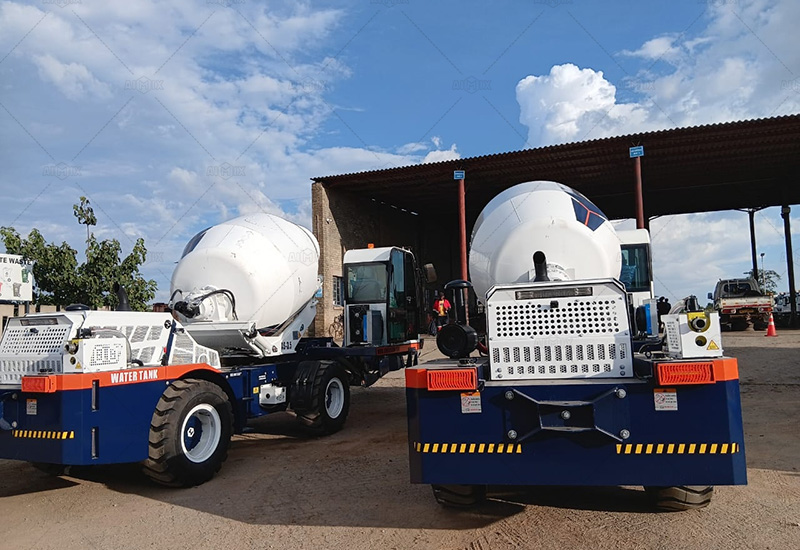
Let us be direct. The allure of a bargain is potent, especially when your construction margins in Addis Ababa or Dire Dawa are being relentlessly squeezed. You have seen the online quotes for self loading concrete mixer from faraway ports. The price tag, stripped of taxes and logistics, appears mercifully low. But there is a pervasive and dangerous assumption lurking here: that a mixer is merely a sum of its steel parts, indifferent to the brutal dust of a Debre Berhan haul road or the languid pace of a local electrical grid. Arguing for the more expensive local distributor is not an act of corporate nostalgia; it is a strategic defense against operational bankruptcy. The extra cost is not an expense. It is an insurance premium against paralysis.
1. The Mirage of the Direct Import and the Specter of Downtime
Buying directly from an overseas manufacturer feels like a victory. You have circumvented the middleman. Yet, you have also severed the lifeline. When a proprietary hydraulic hose bursts on a Friday afternoon in a rural zone, who answers your call? The foreign supplier’s email auto-responder certainly will not. The local distributor charges more because they store that specific hose, the unique planetary gear seal, and the arcane circuit board for the weighing system. They keep a mechanic who has seen the machine vomit its lubricants before. Without this, your mixer becomes a very expensive, very rusting sculpture. You lose not just a day, but possibly the entire concrete pour schedule for a school’s foundation.

1.1 The Tyranny of Spare Parts Latency
Consider the lead time. An airfreighted bolt from Guangzhou or Ankara takes a minimum of seventy-two hours, if customs cooperates. Ocean freight is a cruel joke lasting weeks. Local distributors maintain a consignment stock. They have already paid the duty and absorbed the warehousing cost. This is why their shelf price is higher. They are trading capital for your convenience. You are paying for the guarantee that the replacement sensor arrives before the concrete in the drum turns to stone.
1.2 The Competence of Local Technical Acumen
Remote troubleshooting has limits. A video call cannot smell burnt insulation or feel the irregular vibration of a faulty charging pump. Local distributors train technicians on the specific eccentricities of the Ethiopian terrain—the pervasive fine silt that clogs air filters, the voltage sags common in outlying industrial parks. This tacit knowledge is irreplaceable. Attempting to diagnose a misaligned drum rotation via a translated manual is an exercise in futility. The argument is simple: pay now for a mechanic who speaks Amharic or Oromo and understands your site’s reality, or pay later for a heap of scrap.
2. Beyond the Machine: The Hidden Costs of Calibration and Compliance
You might think a concrete mixer machine is a blunt instrument. It is not. It is a precision batching laboratory on wheels. The self loading mechanism relies on accurate load cells and water flow meters. Ethiopia has its own standards, often loosely enforced but critically important for project sign-offs. An imported machine arrives calibrated for the sea-level atmosphere of a foreign factory, not the high-altitude, low-oxygen environment of the Ethiopian highlands. This discrepancy leads to inconsistent slump and compromised compressive strength. Local distributors pre-commission the units. They adjust the logic controllers for local aggregate density and ambient barometric pressure. This recalibration is a non-negotiable service.
2.1 Navigating the Procurement Labyrinth
Customs clearance for heavy machinery is a notorious bottleneck. Demurrage charges at the port of Djibouti accumulate with terrifying velocity. The local distributor has a customs agent on retainer. They understand the harmonized system codes and the fluctuating surtaxes on diesel engines. Paying for this expertise bypasses weeks of bureaucratic purgatory. The direct importer leaves you to navigate this maze alone, armed only with a commercial invoice. The time value of money evaporates as your project waits for a single stamp.
2.2 The Warranty as a Strategic Weapon
A foreign warranty is a piece of paper. A local warranty is a relationship. When the distributor holds a bond with the manufacturer, they are incentivized to fight for your claim. They will process the paperwork for a defective mixer drum or a failing hydraulic pump because their reputation is on the line. Without them, you are a lone voice shouting into a void. You cannot fly to the factory to argue about metal fatigue. The local distributor acts as your proxy, your legal shield. That function has a cost, but litigation has a far higher one.

3. The Final Verdict: Holistic Cost of Ownership versus Sticker Price
The debate is not about affordability. It is about value preservation. A self loading mixer in Ethiopia is a circulatory system for a construction site. When it fails, the entire project suffers a stroke. Choosing the cheaper, distant vendor is a gamble on perfect reliability, a state that does not exist in mechanical engineering. The local distributor sells a buffer against entropy. They provide the training for your operators to avoid overfilling the skip. They offer the financing options that align with Ethiopian birr cash flow cycles. The extra cost at the point of sale is the subtraction of risk from the balance sheet.
3.1 The Fallacy of the Sole Proprietor Mentality
Many contractors pride themselves on being self-sufficient. They keep a garage full of tools and a roster of general mechanics. This is admirable, but it is also a fallacy when dealing with a self loading concrete mixer’s proprietary electronics. You cannot reprogram the PLC with a wrench. You cannot reverse-engineer the volumetric metering algorithm. The local distributor holds the diagnostic software and the license keys. Arguing against this specialization is arguing for a return to manual mixing, which defeats the entire purpose of the investment. Embrace the interdependence; it is the engine of efficiency.
3.2 Making the Data-Driven Choice
Look at the ledger of the last five years. Do you see unplanned stoppages? Do you see projects that missed deadlines because of equipment failure? Multiply those losses by the cost of your unproductive labor and idle machinery. Now compare that figure to the premium charged by the reputable local distributor. The math is brutal and uncompromising. The local distribution channel is worth the extra cost because it buys you time, and in the construction industry, time is the only truly non-renewable resource. Pay for the presence. Pay for the parts. Pay for the peace of mind. Anything else is a betrayal of your own project’s longevity.
Comments
No comments yet. Be the first to react!