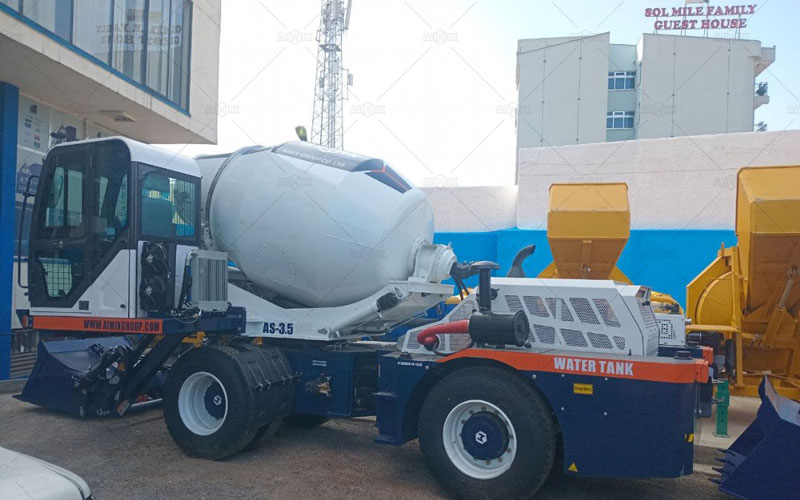
The self loading concrete mixer truck is a paradigm of mobile batching, integrating aggregate weighing, mixing, and transport into a single, cohesive unit. Its operational efficacy, however, is contingent upon a robust and responsive drivetrain, particularly when deployed in the demanding, unstructured terrain typical of many construction sites. The interface between the prime mover and the driving wheels is mediated by the hydraulic transmission system. This system is not merely a convenience; it is the determinant of the machine’s tractive effort, its maneuverability, and its ability to maintain productivity in suboptimal ground conditions. This article provides a technical analysis of how the hydraulic transmission architecture directly governs the off-road performance and operational resilience of the versatile self loading concrete mixer truck.
1. Tractive Effort and Torque Management
The fundamental requirement for off-road mobility is the capacity to deliver sufficient tractive force to overcome rolling resistance and gradients. The hydraulic transmission is the orchestrator of this force delivery.
Hydrostatic vs. Mechanical Driveline Dynamics
Unlike a mechanical gearbox that relies on a fixed torque curve, a hydrostatic transmission utilizes a variable displacement pump coupled to a hydraulic motor. This configuration permits infinite variability in torque and speed ratios. When the mixer encounters soft ground or an incline, the system automatically adjusts the hydraulic pressure, effectively “stalling” the motor to increase torque at the wheels while reducing forward speed. This characteristic, known as “torque multiplication,” prevents the engine from stalling and allows the operator to feather the power into the ground, maximizing tractive adhesion without inducing wheel spin. This infinite adaptability is superior to the discrete gear ratios of a mechanical transmission, which often result in either insufficient torque or excessive wheel speed.

Response to Variable Ground Resistance
Off-road substrates present a heterogeneous resistance profile, ranging from compacted clay to loose, granular fill. The hydraulic transmission exhibits an inherent sensitivity to changes in load. As the mixer enters a soft patch, the system pressure rises, and the pump’s swashplate angle adjusts to maintain a constant power output. This “load-sensing” capability ensures that the operator does not need to constantly shift gears to maintain momentum. The concrete mixer machine adapts instantaneously, maintaining a smooth, continuous feed of power that prevents the sudden jerking motions that can destabilize the heavy, rotating drum of a fully loaded mixer.
2. Maneuverability and Steering Precision
Beyond brute force traction, the agility of a self loading mixer is critical. The hydraulic system provides a level of control fidelity that is unattainable with mechanical linkages.
Hydrostatic Steering and Articulation
Many self loading mixers feature articulated frames, which allow the front and rear sections to pivot relative to each other. This articulation is typically actuated by hydraulic cylinders. The use of hydraulics for steering provides a distinct advantage: infinite steering lock and proportional control. An operator can make minute, calculated adjustments to the articulation angle, which is essential for navigating around obstacles and through tight entryways. This high level of control reduces the turning radius and mitigates the risk of the mixer becoming high-centered on uneven terrain.
Independent Circuit Control for Counter-Rotation
Certain advanced hydraulic systems offer independent control of the left and right wheel motors. This capability allows for “counter-rotation,” where the wheels on one side of the machine rotate in the opposite direction to the other. This effectively turns the mixer on its own axis, a maneuver of immense utility in confined spaces or when repositioning on a narrow access road. This is a direct consequence of the hydraulic architecture, which requires only a valve manifold to isolate and reverse the flow to specific motors, an impossible feat for a conventional mechanical axle.
3. Thermal Management and Sustained Performance
The off-road operation of a hydraulic transmission generates significant thermal energy. The ability of the system to dissipate this heat is critical to maintaining performance and preventing component failure.

Hydraulic Fluid Viscosity and Efficiency
The viscosity of hydraulic oil is temperature dependent. The intense cycles of high-pressure operation inherent in off-road work—characterized by frequent starts, stops, and steering inputs—rapidly elevate the oil temperature. If the fluid exceeds its optimal operating range, its viscosity drops, leading to a reduction in volumetric efficiency, increased internal leakage, and a corresponding loss in tractive power. A well-designed system incorporates an oversized oil cooler, often thermostatically controlled, which is essential to maintain the fluid’s viscosity within its optimal window. This thermal regulation ensures consistent performance over prolonged work hours.
Derating and Overheating Protection
Modern hydraulic systems incorporate thermal sensors that provide feedback to the big concrete mixer machine’s electronic control unit (ECU). Should the fluid temperature approach the critical threshold, the ECU may initiate a “derating” sequence. This involves reducing the engine RPM and limiting the hydraulic flow, thereby reducing the heat generation rate. While this temporarily reduces performance, it acts as a protective mechanism, preventing the catastrophic failure of seals and pumps. Understanding this interplay is crucial; an operator must be aware that prolonged heavy operation in soft sand or steep inclines may trigger this protective mode, requiring them to allow the system to cool to restore full performance.
Comments
No comments yet. Be the first to react!