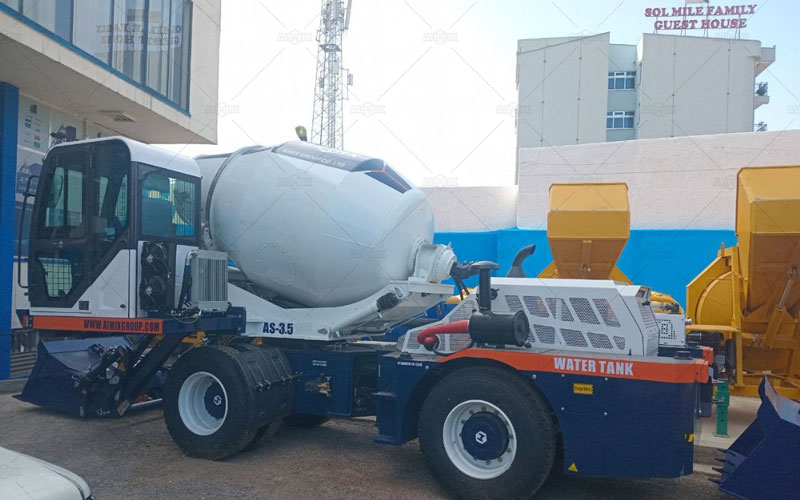
Let us talk about hills. Not the gentle slopes of a suburban driveway. Real hills. Mountain roads with gradients of 15, 20, even 30 percent. If you work in a mountainous region, your self loading concrete mixer truck must climb these grades. Not slowly. Not dangerously. Reliably. The specification that tells you whether a machine can handle the hills is called gradeability. It is measured as a percentage. A 20 percent grade means the machine climbs 20 metres vertically for every 100 metres horizontally. This article explains gradeability. It tells you what numbers to look for. It explains why a machine with good gradeability on paper may still struggle in the real world. The tone is matter of fact. The style is conversational. The goal is to help you choose a machine that will not let you down on the mountain.

##What Gradeability Means and How It Is Calculated
The Basic Formula
Gradeability is the maximum slope a machine can climb. It is determined by three factors. Engine power. Machine weight. Traction. The formula is simple. More power and better traction increase gradeability. More weight decreases it. A machine with a 100-horsepower engine and a weight of 5 tonnes will climb a steeper hill than a machine with the same engine and a weight of 8 tonnes. The formal definition is that gradeability is expressed as the tangent of the angle of ascent. A 20 percent grade corresponds to an angle of approximately 11.3 degrees. A 30 percent grade corresponds to approximately 16.7 degrees. Most [self loading mixers in Peru](https://aimixconcretesolution.com/self-loading-concrete-mixer/peru/
) have a gradeability of 15 to 25 percent. Some specialised machines reach 30 percent.
Why the Brochure Number Is Not the Whole Story
The gradeability number in the brochure assumes ideal conditions. The machine is empty. The tyres are new. The surface is dry concrete or asphalt. Your mountain road is not ideal. The machine is loaded with 3 tonnes of wet concrete. The tyres are half worn. The surface is loose gravel or wet clay. Each of these factors reduces the effective gradeability. A machine rated for 25 percent may only manage 15 percent under load. The conversational advice is to ask the manufacturer for a gradeability curve. This curve shows the maximum slope at different loads. A reputable supplier will provide it. A supplier who cannot provide it has not tested the machine properly.
Real-World Factors That Affect Climbing Ability
Traction and Tyre Selection
Power is useless without traction. A machine with 200 horsepower will not climb a muddy slope if its tyres spin. The tyre tread pattern determines traction. Road tyres have shallow treads. They work on pavement. They fail on dirt. Bar tread or agricultural tyres have deep lugs. They bite into soft surfaces. The formal recommendation is to specify bar tread tyres if you work on unpaved mountain roads. The ride will be rougher. The traction will be much better. You should also consider tyre pressure. Lower pressure increases the contact patch. It improves traction on soft ground. The trade-off is increased tyre wear on paved sections.
Ground Clearance and Approach Angles
A steep hill is not the only challenge. Mountain roads have ruts, rocks, and drainage dips. A machine with low ground clearance will high-centre. The chassis will rest on the rock. The wheels will lift off the ground. The machine will not move. The specification you need is the ramp breakover angle. This is the maximum angle the machine can traverse without the underbelly touching the ground. A machine with a short wheelbase and high ground clearance has a good breakover angle. A machine with a long wheelbase and low ground clearance will get stuck. The conversational advice is to look at the machine from the side. The space between the wheels under the chassis should be generous. If it looks tight, the machine will struggle on uneven terrain.

Practical Tips for Mountain Operation
Load Management
You cannot always control the machine’s specifications. You can control the load. A fully loaded [self loading concrete mixer in Chile](https://aimixconcretesolution.com/self-loading-concrete-mixer/chile/
) weighs significantly more than a half-loaded one. The gradeability decreases as weight increases. The formal recommendation is to reduce the batch size on steep climbs. A machine rated for 2 cubic metres may only manage 1.5 cubic metres on a 20 percent grade. The trade-off is more trips. The alternative is a stuck machine. The choice is clear. Reduce the load. Make the climb. Complete the pour.
Braking and Descents
Climbing is one challenge. Descending is another. A heavy machine on a steep downhill grade requires effective braking. The service brakes may overheat. Brake fade reduces stopping power. The formal recommendation is to select a machine with an exhaust brake or a hydraulic retarder. These auxiliary braking systems absorb energy without overheating the service brakes. They allow the machine to descend at a controlled speed. The operator should also use a low gear. The transmission should be in the same gear for the descent as for the ascent. Low gear provides engine braking. It reduces the load on the service brakes.
The matter-of-fact conclusion is that gradeability is a critical specification for self-loading mixer trucks in mountain regions. The number in the brochure is a starting point. Real-world factors like load, tyre condition, and surface quality affect the actual climbing ability. Contractors working in mountainous areas should prioritise traction, ground clearance, and auxiliary braking. They should reduce loads on steep climbs. They should test the machine on representative terrain before committing to a purchase. A machine that cannot climb the hill is a machine that cannot do the job. Choose accordingly.
Comments
No comments yet. Be the first to react!