The Middle East is undergoing one of the most concentrated periods of infrastructure and urban development in its modern history. Across Saudi Arabia, the UAE, Qatar, Kuwait, and Oman, construction programs of extraordinary scale are advancing simultaneously — from the NEOM megacity project in northwestern Saudi Arabia to port expansions along the Gulf coast, from metropolitan transit networks threading beneath Dubai and Riyadh to industrial city developments generating aggregate demand that regional quarry supply chains are working hard to sustain. The concrete volumes involved are staggering. And where large volumes of concrete are placed, large volumes of concrete eventually require demolition, recycling, or processing — a downstream demand dynamic that is driving accelerating investment in concrete crusher machine across the region.
The relationship between construction growth and crusher machine demand is not simply linear. It operates through multiple simultaneous mechanisms: the demolition of existing structures to make way for new development, the recycling of construction and demolition waste into reclaimed aggregate that reduces dependence on quarried material, the processing of concrete rubble generated by infrastructure renewal programs, and the production of recycled concrete aggregate for sub-base and fill applications where virgin aggregate supply is geographically constrained or economically prohibitive. Understanding these mechanisms — and the regional factors that amplify their effect in the Middle East specifically — explains why the market for concrete crusher machines in this region is expanding at a rate that equipment manufacturers and distributors are finding genuinely difficult to supply ahead of demand.
Infrastructure Renewal and Urban Redevelopment as Primary Demand Drivers
The Middle East’s current construction wave is not occurring on entirely undeveloped land. A significant portion of the region’s most active development zones contain existing built infrastructure — older residential districts, industrial facilities, commercial developments, and transportation infrastructure constructed during earlier development phases that now require either demolition to clear sites for new development or structural renewal that generates substantial concrete demolition waste. Processing this waste economically requires mobile and stationary concrete crusher machines capable of reducing large-diameter reinforced concrete demolition material to specification-grade recycled aggregate.

Demolition Waste Generation from Urban Renewal Programs
Urban renewal programs in Saudi Arabia’s major cities — Riyadh, Jeddah, and Dammam — are generating concrete demolition volumes that traditional waste disposal approaches cannot absorb economically. Landfill disposal of concrete demolition waste imposes transport costs, tipping fees, and increasingly stringent regulatory compliance requirements that make on-site or near-site crushing and recycling the operationally and economically preferable alternative. Mobile jaw crusher and impact crusher combinations, positioned at demolition sites, reduce reinforced concrete rubble to recycled concrete aggregate that can be immediately utilized as structural fill, road sub-base material, or drainage layer aggregate within the development program generating it.
The economic argument for on-site concrete crushing in urban renewal contexts is compelling. Eliminating demolition waste haulage — which in congested Middle Eastern urban environments carries both direct cost and schedule implications — while simultaneously producing aggregate material that would otherwise require procurement from quarry sources or import supply chains creates a dual financial benefit that experienced demolition and earthworks contractors in the region have recognized and acted upon. Concrete crusher machine investment in this context delivers return through waste disposal cost avoidance as much as through aggregate production value.
Reinforced Concrete Processing Requirements and Equipment Implications
Demolition concrete from Middle Eastern construction programs is predominantly reinforced — structural frames, shear walls, foundation elements, and pavement slabs that contain steel reinforcement at densities that impose specific processing requirements on crusher machine selection. Primary jaw crushers handling reinforced concrete demolition feed must accommodate steel reinforcement bars passing through the crushing chamber without causing mechanical damage to jaw plate retention systems or drive components. Hydraulic overload protection systems — standard on quality jaw crusher designs — protect against tramp metal events by allowing the jaw’s closed-side setting to open momentarily when an uncrushable object enters the chamber, releasing it without imposing destructive load on the machine’s structural members.
Aggregate Supply Constraints and the Recycled Material Opportunity
The Middle East’s geological and geographic characteristics create natural aggregate supply constraints that amplify the economic value of recycled concrete aggregate. The Arabian Peninsula’s predominantly sedimentary geology limits the availability of hard, durable crushed rock aggregate in proximity to major construction centers. Quarry sources for premium aggregate in Saudi Arabia’s central and eastern provinces are geographically distant from the highest-demand construction zones, imposing haulage costs that escalate delivered aggregate prices significantly above quarry gate prices. The UAE imports substantial volumes of aggregate from Oman and further afield to supplement domestic quarry production that cannot meet the pace of construction demand.
Recycled concrete aggregate produced by concrete crusher machines from demolition waste provides a supplementary supply source that reduces dependence on long-haul quarry aggregate for applications where recycled material meets specification requirements. Road sub-base and base course applications, structural fill, drainage aggregate, and in some regulatory frameworks, lower-grade structural concrete production — these end uses collectively represent a substantial volume of aggregate demand that recycled concrete aggregate can address, with material produced at or near the point of generation rather than transported from distant quarry sources.

Megaproject Construction Waste Management as a Systemic Demand Factor
Saudi Arabia’s Vision 2030 infrastructure pipeline includes project scales that generate construction waste volumes with no historical precedent in the region. NEOM alone — a 26,500 square kilometer development program encompassing linear city infrastructure, mountain resort facilities, and coastal development — will generate concrete demolition and construction waste recycling throughout its multi-decade development timeline that requires systematic processing capability rather than project-by-project improvisation. The institutional recognition of this requirement is driving procurement of concrete crusher machines at program rather than project scale — a procurement approach that reflects the maturation of the regional construction industry’s approach to waste management as an engineered system rather than an operational afterthought.
On-Site Crushing Integration in Large-Scale Project Logistics
Large megaproject construction programs in the Middle East are increasingly incorporating on-site crushing operations as an integral component of the project’s materials management system rather than a supplementary activity. Concrete crusher machines positioned within the project boundary process demolition and construction waste into recycled aggregate that feeds back into the project’s ongoing construction material requirements — road base for internal haul routes, fill material for earthworks programs, drainage aggregate for stormwater infrastructure — creating a closed-loop material cycle that reduces both virgin aggregate procurement costs and waste disposal logistics complexity.
The logistical benefit of on-site crushing in megaproject contexts extends beyond material cost reduction. Reducing outbound waste haulage volume and inbound aggregate delivery volume simultaneously decreases the traffic load on haul routes that, in remote megaproject locations, represent significant infrastructure investments in their own right. Fewer heavy vehicle movements translates to reduced haul road maintenance costs, lower fuel consumption across the haulage fleet, and reduced dust generation in the environmentally sensitive desert environments where several major Middle Eastern projects are located — a sustainability benefit that increasingly features in project environmental management plan compliance requirements.
Stationary Versus Mobile Crusher Configuration Selection for Megaproject Applications
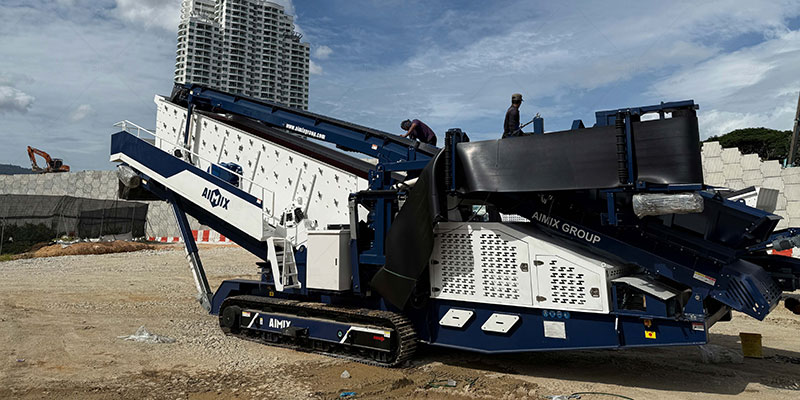
Megaproject concrete crusher procurement decisions involve a configuration choice — stationary versus mobile plant — that reflects the specific material flow dynamics of each project program. Stationary crushing installations, positioned at central waste reception and processing facilities within the project boundary, offer higher throughput capacity and lower operating cost per tonne at sustained production volumes. They are appropriate where demolition waste can be economically hauled to the central facility from generation points distributed across the project area. Mobile crusher configurations — track-mounted jaw and impact crusher units that reposition to follow demolition activity — minimize the haul distance between waste generation and processing by bringing the crusher to the material rather than the material to the crusher. For projects where demolition fronts advance progressively across a large geographic area, mobile configurations consistently deliver lower total material handling costs despite their higher unit operating cost compared to stationary plants. The correct configuration choice depends on a rigorous analysis of haul distance economics, production volume requirements, and the temporal distribution of demolition waste generation across the project timeline — an analysis that the Middle East’s most sophisticated project developers are now conducting as standard practice rather than treating equipment configuration as a secondary procurement decision.
Comments
No comments yet. Be the first to react!