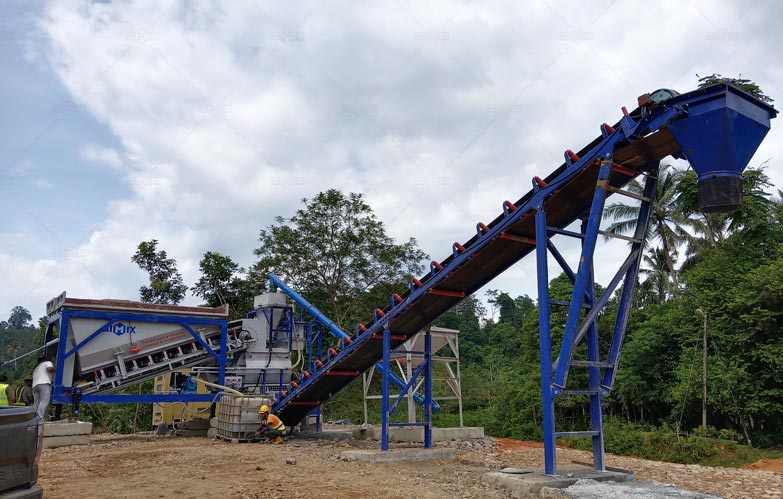
On a bustling construction site, the steady pour of high-quality concrete is the lifeblood of progress. For projects in remote locations, constrained spaces, or with phased timelines, the mobile concrete plant has emerged as a game-changing solution. It functions as a complete, on-site factory, transforming raw, inert materials into a ready-to-use engineered product. Understanding this seamless, self-contained process—from aggregate pile to poured slab—reveals why this technology is invaluable for modern construction, especially when considering overall project efficiency versus just the initial concrete plant price.
Stage 1: Ingredient Reception and Storage – The Foundation of the Mix
Every great batch of concrete starts with precise raw materials. A small concrete plant is uniquely designed to handle this crucial first stage with compact efficiency.
Aggregate Handling and Storage
The process begins with aggregates—sand, gravel, or crushed stone. These are typically delivered by dump trucks and stored in segregated feed hoppers or small stockpiles adjacent to the plant. Many mobile concrete plants(planta de concreto movil) feature integrated feed hoppers with multiple compartments, allowing for different aggregate sizes (e.g., fine and coarse) to be kept separate but instantly accessible. In some setups, wheel loaders are used to transfer material from ground stockpiles into these hoppers.
Cement and Water Supply
Cement, the binding agent, is stored in a sealed silo mounted directly on the plant's trailer frame. This silo keeps the powder dry and protected from the elements. Water, another critical component, is stored in a large tank, also integrated into the mobile unit. For precise control in varying climates, some plants also include tanks for liquid admixtures (like accelerators or plasticizers), which are added in small, measured amounts to modify the concrete's properties.
Stage 2: Precise Batching and Weighing – The Heart of Quality Control
This is where accuracy is paramount. The mobile batching plant's computerized control system is the brain that ensures every batch meets the exact engineering specifications.
Automated Measuring
When a batch is initiated, the control system automatically gates the correct amount of each aggregate from the storage hoppers onto a built-in conveyor belt or directly into a weigh batcher. Each aggregate type is weighed separately or cumulatively to ensure the correct proportion. Simultaneously, the system meters the precise weight of cement from the silo and the exact volume of water from the tank. For a small concrete plant(planta de concreto pequeña), this automation is just as sophisticated as in larger models, guaranteeing mix consistency batch after batch, which is vital for structural integrity.
The Role of the Control Panel
The operator inputs the specific mix design (e.g., a 3000 psi mix for a foundation) into the panel. The system then executes the recipe, eliminating human measurement error. This repeatable precision directly impacts the final product's strength and durability, protecting the project's value far beyond the initial equipment consideration.
Stage 3: Mixing – Where the Transformation Happens
With all ingredients accurately measured, they converge in the mixing unit—the core component where raw materials become cohesive concrete.
Charging the Mixer
The weighed aggregates are typically conveyed into the mixer first, followed by cement and water. In a central mix mobile plant, this mixing occurs in a forced-action mixer, such as a twin-shaft paddle mixer, which ensures a thorough, homogeneous blend. This type of mixing is highly efficient and produces a consistent, high-quality product ready for immediate placement.
The Mixing Cycle
The mixer rotates for a predetermined time, ensuring all components are fully integrated. The water hydrates the cement particles, starting the chemical reaction that will eventually lead to hardening. During this cycle, any liquid admixtures are injected, perfectly dispersing throughout the mix to achieve the desired workability, set time, or other characteristics.
Stage 4: Discharge and Delivery – The Final Step to Placement
The now-finished concrete product must be quickly and efficiently transferred to the point of placement before it begins to set.
Discharge into Transport Equipment
Upon completion of the mixing cycle, the mixer drum discharges the fresh concrete. In a standard setup, the concrete pours directly into a waiting concrete transport truck (a mixer truck or agitator). In other configurations, particularly for a very compact mobile concrete plant, the concrete may be discharged into a concrete pump's hopper, a dump truck, or even directly into wheelbarrows or concrete carts for smaller-scale work.
Just-in-Time Production
This is the culmination of the mobile plant's greatest advantage: proximity. There is no long transit time from a distant stationary plant. The concrete is mixed and discharged on-demand, often within sight of where it will be poured. This guarantees that the concrete retains its specified slump (workability) and is placed before any detrimental setting begins, resulting in a superior final finish and strength.
Conclusion: A Symphony of Efficiency on Your Site
A mobile concrete plant is far more than just a piece of machinery; it is a complete, portable production line. It masterfully orchestrates the journey of raw materials through storage, precise computer-controlled batching, vigorous mixing, and timely discharge. This closed-loop process provides unmatched control over quality, cost, and schedule. For project managers weighing the benefits, the value lies not merely in the concrete plant price(planta de hormigón precio), but in the savings from reduced waste, eliminated long-haul transportation, guaranteed mix consistency, and the sheer flexibility to keep pace with any project's demands. By completing the entire process from raw materials to finished product at the source, the mobile batching plant turns any accessible site into a center of efficient, reliable concrete production.

Comments
No comments yet. Be the first to react!