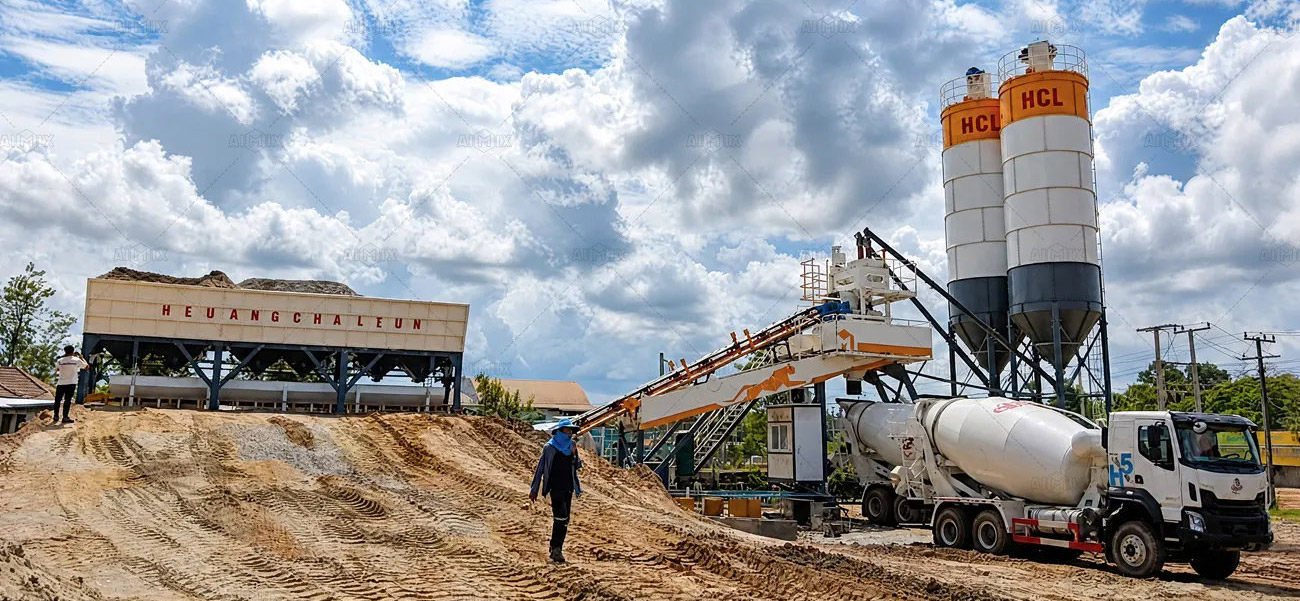
When contractors compare concrete production equipment, the initial concrete plant price is often one of the first factors they examine. However, a quick assembly system such as the AJQ70 quick assembly concrete plant may have a different cost structure from a conventional concrete mixing plant. Its value comes not only from the equipment itself, but also from reduced installation work, shorter preparation periods, and greater flexibility during project execution.
For remote infrastructure, road construction, mining, and other projects with demanding schedules, a higher initial equipment investment does not necessarily mean higher overall project costs. The key is to evaluate the total cost of installation, operation, relocation, and supporting infrastructure.
What Determines the Cost of a Quick Assembly Concrete Plant?
The concrete plant price of a quick assembly system is influenced by more than its production capacity. Its structural design, control system, transportation configuration, installation method, and included components can all affect the final investment.
Modular Structural Design
Quick assembly plants are designed around modular components that can be transported and assembled efficiently. This requires careful engineering and manufacturing to ensure that the modules can be connected quickly while maintaining structural stability and production performance.
The AJQ70 quick assembly concrete plant(AJQ70 planta de concreto de montaje rápida) uses an integrated modular structure designed to simplify field assembly. Compared with a conventional concrete plant that may require more extensive civil construction, this approach shifts more preparation and assembly work to the manufacturing stage.
Integrated Electrical and Control Systems
Another cost factor is the degree of factory integration. Pre-installed electrical components, control systems, connectors, and other components can increase manufacturing complexity.
However, factory integration can reduce the amount of wiring, assembly, and commissioning required at the jobsite. Contractors should therefore consider both the equipment cost and the field labor required before comparing different concrete plant options.
Where Can Quick Assembly Plants Reduce Project Costs?
The main financial advantage of a quick assembly concrete plant is not necessarily a lower purchase price. Instead, savings can come from reducing supporting project costs.
Lower Civil Construction Requirements
Traditional concrete plants may require substantial foundations and supporting civil works before installation. These works can involve concrete, reinforcement, excavation, labor, and additional construction equipment.
A foundation-free or simplified-foundation design can reduce these requirements when site conditions are suitable. This is particularly useful for temporary projects or remote jobsites where transporting construction materials is expensive.
Shorter Installation Time
Installation time affects more than the equipment schedule. While a concrete mixing plant(planta mezcladora de concreto) is being installed, other construction activities may also be waiting for concrete production to begin.
A quick assembly system can shorten the period between equipment arrival and production. Earlier concrete production may help contractors start foundations, roads, bridges, or other concrete-intensive work sooner.
Reduced Labor and Equipment Requirements
Conventional installation may require multiple workers and construction machines for assembly and civil works. A quick assembly design can reduce the amount of field work required.
The potential savings can include:
- Fewer days of installation labor
- Less temporary construction equipment
- Reduced civil-work requirements
- Lower site preparation costs
- Shorter commissioning periods
The actual savings depend on local labor rates, site conditions, transportation costs, and project requirements.
How Should Contractors Evaluate Concrete Plant Price?
Comparing the purchase price alone can produce a misleading result. Contractors should calculate the total project investment using several cost categories.
| Cost Factor | Conventional Plant | Quick Assembly Plant |
|---|---|---|
| Equipment purchase | Depends on configuration | Depends on configuration |
| Foundation work | Often required | Can be reduced depending on design |
| Installation labor | Potentially higher | Potentially lower |
| Site preparation | More extensive in some projects | Generally simplified |
| Installation duration | Project-dependent | Designed for faster assembly |
| Relocation | Can require significant work | More adaptable for relocation |
This approach helps contractors compare the actual cost of getting a concrete production system operational rather than simply comparing equipment quotations.
When Does a Higher Initial Investment Make Sense?
A quick assembly plant can be particularly valuable when installation speed and mobility have a direct impact on project costs.
Consider a project where a conventional concrete plant requires additional foundation construction, extended installation, and more field labor. Even if its equipment quotation is lower, these additional expenses can increase the total project investment.
The AJQ70 quick assembly concrete plant is designed for projects where rapid deployment is important. Its modular structure can help reduce the infrastructure and field assembly associated with conventional installations.
Suitable Project Conditions
Quick assembly systems can be considered for:
- Highway and road construction
- Bridge and tunnel projects
- Mining infrastructure
- Hydropower construction
- Remote construction sites
- Temporary or phased projects
- Projects requiring future relocation
Look Beyond the Equipment Quotation
The right concrete plant price(planta de concreto precio) should be evaluated against the complete project cost. Equipment purchase, foundation construction, installation labor, transportation, commissioning, relocation, and downtime can all influence the final investment.
For contractors working under tight schedules or in locations where civil construction is expensive, the additional investment in a quick assembly system may be offset by savings elsewhere in the project.
The AJQ70 quick assembly concrete plant demonstrates why equipment selection should be based on total project economics rather than purchase price alone. By combining modular construction with simplified installation and flexible deployment, a quick assembly concrete plant can help contractors control both initial infrastructure requirements and the time needed to begin concrete production.

Comments
No comments yet. Be the first to react!