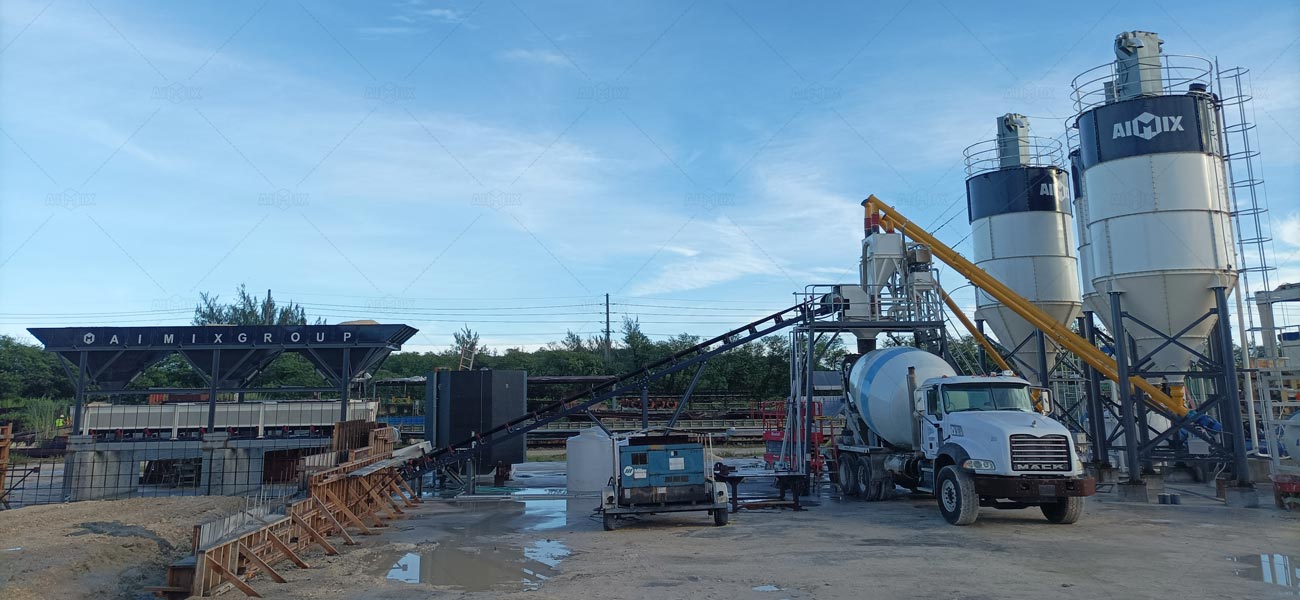
When contractors compare a concrete batching plant price, they may notice large differences between stationary, mobile, compact, and pumped configurations. These differences are not simply caused by production capacity. Plant structure, mobility, installation requirements, concrete delivery methods, automation, and supporting equipment can all affect the final investment.
For construction projects in Latin America, selecting the right plant requires more than comparing supplier quotations. A mobile concrete plant Peru project, for example, may prioritize transportation and rapid relocation, while a permanent urban development project may benefit more from a stationary system with higher automation and storage capacity.
A ready-mix concrete plant designed for commercial concrete supply also has different requirements from a plant serving a single highway, bridge, or remote construction site. Understanding these differences helps buyers evaluate quotations more accurately and avoid paying for features they do not actually need.
What Determines Concrete Batching Plant Price?
The concrete batching plant price(planta dosificadora de concreto precio) is influenced by several technical and commercial factors. Capacity is important, but it is only one part of the calculation.
Production Capacity and Configuration
A plant producing 25 m³/h will generally require fewer aggregate bins, smaller conveyors, and a lower-capacity mixer than a 60 m³/h or 120 m³/h system. However, plants with the same nominal output can still have different prices because of their configuration.
Key factors include:
- Mixer type and capacity
- Number and size of aggregate bins
- Cement and additive weighing systems
- Conveyor or skip feeding system
- Control and automation system
- Cement silo capacity
- Dust collection and environmental equipment
Therefore, comparing only the advertised hourly capacity can produce an inaccurate assessment of value.
Why Are Stationary Concrete Plants Usually Different in Price?
Stationary plants are designed for long-term operation at a relatively fixed location. Their structures can accommodate larger aggregate storage systems, cement silos, conveyors, and other supporting equipment.
Higher Infrastructure Requirements
A stationary concrete batching plant may require foundations, steel structures, aggregate storage areas, electrical infrastructure, and permanent access arrangements. These additional requirements can increase the total project investment even when the equipment quotation itself appears competitive.
For large commercial or infrastructure projects, however, the higher initial investment can be justified by stable production, large storage capacity, and efficient continuous operation.
Why Can Mobile Concrete Plants Have Different Prices?
Mobility changes the design philosophy of the equipment. A mobile plant is engineered to simplify transportation, installation, and relocation between construction sites.
Lower Relocation Costs
For projects that move between different work zones, a mobile concrete plant can reduce downtime associated with dismantling and rebuilding a conventional stationary system.
A mobile concrete plant Peru(planta de concreto móvil Perú) buyer should consider not only the purchase quotation but also road accessibility, transportation regulations, site conditions, and the expected number of relocations during the project's lifecycle.
In some cases, paying more for a mobile configuration can reduce overall project costs because the equipment can be reused at subsequent construction sites.
What Makes Compact Concrete Plants Different?
Compact plants focus on reducing the physical footprint and simplifying installation. They are particularly useful where construction sites have limited space or where contractors want to reduce civil engineering work.
Installation and Space Requirements
Compared with conventional plants, compact designs may integrate components more efficiently and reduce the space required for equipment installation.
This can be valuable for:
- Urban construction projects
- Commercial building sites
- Infrastructure projects with restricted space
- Temporary concrete production sites
- Contractors who frequently establish new work locations
The key point is that a lower footprint does not necessarily mean a lower concrete batching plant price. Compact engineering can require specialized structural design and integrated components, so buyers should evaluate the total value rather than assuming smaller equipment is always cheaper.
Why Are Pumped Concrete Batching Plants Priced Differently?
Pumped batching plants combine concrete production with a concrete pumping function. This configuration can change both the equipment cost and the project's logistics.
Integrated Production and Delivery
A conventional batching plant produces concrete, after which mixer trucks transport it to the placement location. A pumped system can deliver concrete directly through a pipeline to areas that may be difficult or inefficient to reach with trucks.
This can be useful for:
- High-rise buildings
- Deep foundations
- Bridge construction
- Tunnels
- Large slabs
- Projects with restricted truck access
Because pumping equipment, hydraulic systems, pipelines, and related controls add to the configuration, the initial quotation may be higher than that of a basic batching plant. However, reduced transportation requirements and faster concrete placement can improve overall project efficiency.
How Should Contractors Compare Different Plant Prices?
Instead of comparing four quotations based only on the equipment price, contractors should evaluate the total cost of ownership.
Consider These Five Questions
- How much concrete is actually required? Match theoretical capacity with average and peak demand.
- How long will the plant stay at one location? Permanent projects generally favor stationary designs, while changing sites may favor mobile equipment.
- How much installation work is required? Compare foundations, assembly, commissioning, and electrical installation.
- How will concrete reach the pouring location? Consider mixer trucks, pumping distance, site access, and delivery time.
- What happens after the current project ends? A mobile or compact plant may provide greater resale or redeployment value.
Choosing Based on Project Economics
The most economical concrete batching plant is not necessarily the one with the lowest initial price. A stationary plant can be more cost-effective for a long-term infrastructure project, while a mobile plant may provide better returns for contractors handling multiple sites. Compact systems can solve space and installation challenges, whereas pumped configurations can reduce concrete delivery complexity.
For buyers comparing a ready-mix concrete plant(planta de concreto premezclado) or specialized project-based system, the best decision comes from evaluating capacity, site conditions, logistics, installation, operating costs, and future equipment utilization together. This broader approach makes the concrete batching plant price easier to understand and provides a more realistic basis for calculating the project's return on investment.

Comments
No comments yet. Be the first to react!