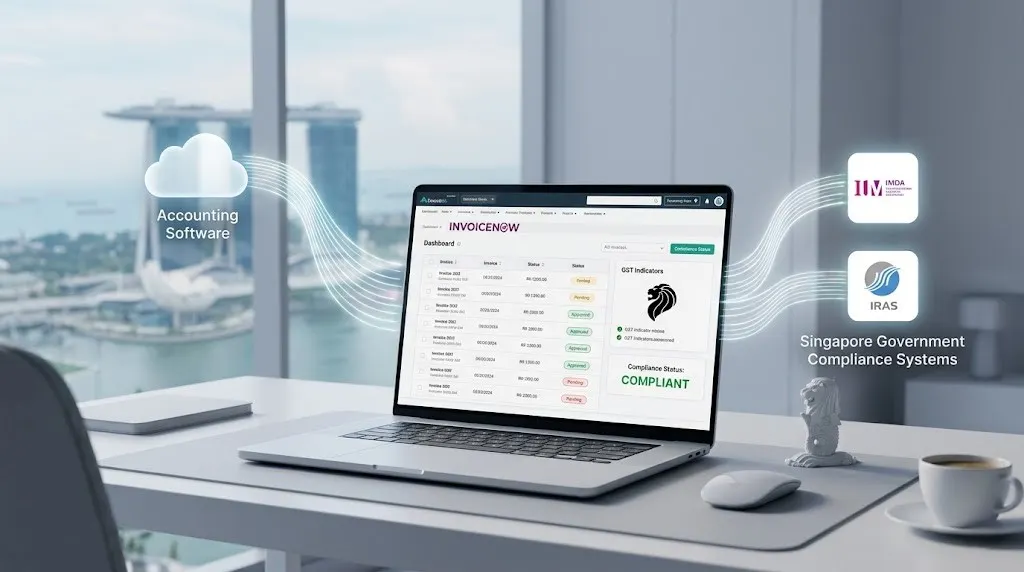
Singapore’s corporate compliance landscape is entering a new chapter. If you’ve been monitoring advisories from professional bodies or regulatory bulletins, one term has risen above the noise: InvoiceNow. Your corporate secretary may have flagged it in a board pack. A tax seminar may have devoted a session to it. For any business weighing voluntary GST registration, the theoretical has become operational.
Effective 1 April 2026, InvoiceNow ceases to be optional for all new voluntary GST registrants. Date of company formation is immaterial. Choice of business vehicle is immaterial. The requirement is universal. Current GST registrants face their own phased introduction, with staged compliance running from 2028 through 2031 based on reported annual supplies.
This is not a peripheral amendment. It signals Singapore’s committed march toward fully digitised tax administration. The immediate horizon demands action; the longer view promises streamlined operations. Here is the complete briefing, stripped of official verbiage.
What InvoiceNow actually is
InvoiceNow represents Singapore’s national e-invoicing backbone, constructed on the Peppol standard recognised across jurisdictions worldwide. The mechanism is straightforward in concept. A seller issues invoice data from their accounting platform. A buyer receives that data, already formatted for direct import into their own system. The manual processing layer vanishes entirely. No duplicate entry. No format translation. No lost correspondence.
For GST compliance, InvoiceNow requires the transmission of specified invoice information to IRAS via an IMDA-endorsed InvoiceNow-Ready Solution. Coverage is thorough: standard-rated supplies, zero-rated transactions, purchase entries, and document types including tax invoices, debit notes, and credit notes. These electronic submissions underpin the figures that appear in your GST returns.
Timing is governed by a simple rule. Transmission must be completed by whichever date comes first: the day you actually submit your return, or the statutory deadline for that return period.
Who needs to act now
The immediate pressure point is voluntary GST registration applications lodged on or after 1 April 2026. InvoiceNow readiness is embedded within the registration process itself. Without evidence of compliance, IRAS may reject the application. The obligation applies equally across entity types—whether you operate as a sole proprietor, in partnership, or through a private limited company.
Existing GST registrants have breathing room, but not indefinite shelter. The rollout schedule begins April 2028, starting with businesses at lower supply thresholds and moving upward in phases. The final phase, in April 2031, applies to those with annual supplies exceeding S$4 million. If you are uncertain which phase applies to you, now is the time to find out. Delayed clarity leads to rushed decisions.
Certain categories are currently outside the scope. Businesses that account for GST solely under the Reverse Charge regime, and entities registered under the Overseas Vendor Registration schemes, are not presently covered. Every conventional Singapore business that issues invoices locally should assume the requirement applies and plan accordingly.
Getting set up: the practical steps
You do not need technical development resources. Leading cloud accounting platforms—Xero, QuickBooks, SAP Business One, and similar—have already incorporated InvoiceNow connectivity through approved service providers. Your first step is to check whether your current system appears on IMDA’s InvoiceNow-Ready Solution Provider list. If it does, your provider can typically activate the functionality and complete your registration on the SG Peppol Directory. You will receive a Peppol ID linked to your Unique Entity Number, which then enables data transmission.
If your existing system is not compatible, alternatives exist. Some providers offer entry-level or no-cost packages specifically designed to meet the GST InvoiceNow requirement. Others provide migration support to move your operations to a compliant platform. The key criterion is choosing a solution that fits your day-to-day workflow, not merely one that satisfies the regulator.
A common point of confusion is transmission timing. Invoice data must reach IRAS by the earlier of your actual filing date or the statutory filing deadline. This means the transmission step must be built into your regular GST process, not handled as a separate, occasional task. A properly configured solution will automate this requirement.
Why this matters beyond compliance
Beyond satisfying the regulator, InvoiceNow addresses practical problems that most businesses encounter. Manual data entry is slow and introduces errors. Email inboxes become black holes for important documents. PDF formats vary and resist automated processing. Structured e-invoicing removes these obstacles. Data flows straight into your accounting records. Reconciliation becomes faster and more reliable. Payment cycles improve.
And if IRAS ever requests supporting documentation, much of your evidence is already in digital form and readily accessible.
For businesses that invoice government agencies, the urgency is heightened. InvoiceNow is becoming the standard channel for public sector vendor billing, and will eventually replace the Vendors@Gov portal. Early adoption protects your ability to continue billing public sector clients without interruption.
Where secretarial services fit in
Businesses with capable internal teams can manage InvoiceNow implementation independently. However, many find value in working with professionals who understand both the technical requirements and the regulatory context. This is where experienced secretarial services Singapore can make a meaningful difference.
A provider of secretary services can assess your operations and recommend the InvoiceNow-ready solution that best matches your needs. They can coordinate with your accountant or IT contacts to ensure your Peppol registration is correctly linked to your UEN. Because they are already managing your ACRA filings, annual returns, and corporate records, they can time InvoiceNow adoption to align with your broader compliance calendar. The aim is not to add another supplier relationship, but to leverage an existing one that already sees the full picture.
This coordination becomes particularly valuable when your corporate structure is changing. For example, if you are incorporating a new entity that will seek voluntary GST registration, good secretarial services will identify the InvoiceNow requirement early in the process. This prevents the requirement from causing delays or creating problems after registration.
Common questions, straightforward answers
Do I still need to keep paper records?
Yes. InvoiceNow does not replace IRAS’s existing record-keeping requirements. You must continue to retain original documents and supporting evidence for the required period. The e-invoice data is an additional layer that supports your records; it does not substitute for them.
What if I only issue a few invoices a month?
The requirement applies regardless of invoice volume. Whether you issue a handful of invoices or hundreds each month, the mandate is the same. The good news is that many InvoiceNow-ready solutions are priced to accommodate small businesses, so you are not forced into expensive enterprise packages.
Can I use a PDF invoice and also transmit via InvoiceNow?
Yes. You can continue to send PDF invoices to your customers for their convenience. The InvoiceNow transmission is a separate, structured data feed that goes directly to IRAS. Your customers do not need to be on the Peppol network for you to meet your compliance obligations.
What happens if I miss the deadline?
For new voluntary GST registrants from April 2026, InvoiceNow adoption is a condition of registration. Failure to comply could result in your application being delayed or rejected. For existing businesses in the later phases, IRAS has indicated a supportive approach during the transition period, but preparing ahead is still the prudent course.
Start where you are
You do not need to have every detail resolved today. Start by understanding your own timeline. If you are considering voluntary GST registration, speak with your accounting or secretary services provider about InvoiceNow-ready options. If you are already GST-registered, identify your phase-in date and use the available lead time to evaluate solutions.
Singapore’s move toward digital tax compliance is part of a broader, irreversible trend. The effort required now will be repaid through cleaner records, fewer manual errors, and smoother interactions with the tax authority. And if you are working with a trusted partner for secretarial services, you have support in navigating the transition rather than facing it alone.
The April 2026 deadline is approaching, but it is well within reach. The key is to approach InvoiceNow not as a hurdle to clear, but as an opportunity to improve how your business handles invoicing—and to stay ahead of what comes next.
Comments
No comments yet. Be the first to react!