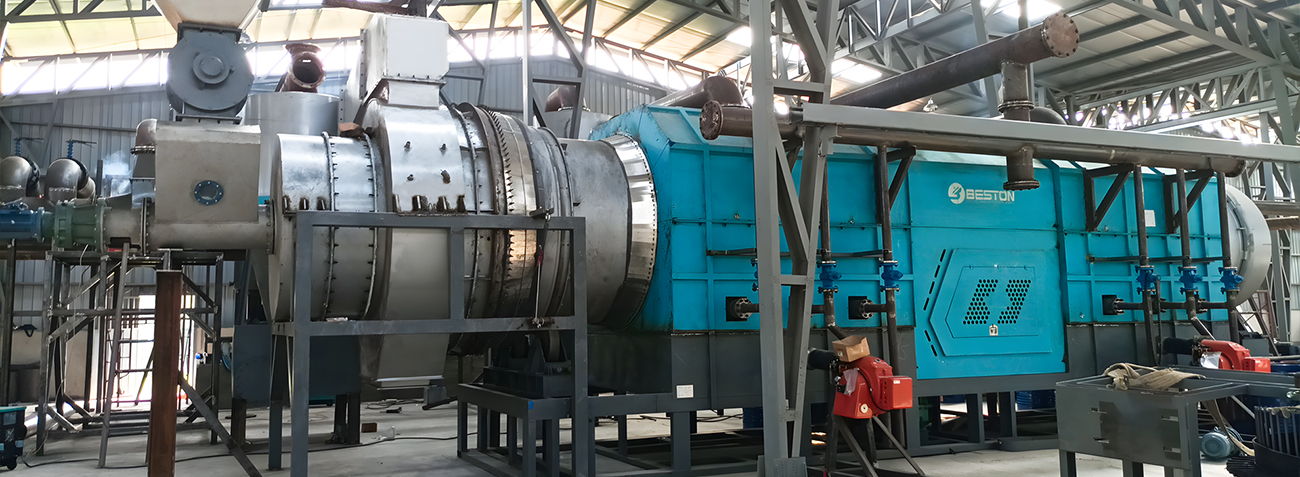
The metallurgical industry relies heavily on carbonaceous materials as reducing agents, carburizing materials, and process additives. Traditionally, these materials may include coke, coal, and other fossil-derived carbon sources. Biochar produced through controlled biomass pyrolysis offers another carbonaceous material for selected metallurgical applications, particularly where renewable carbon, controlled ash content, and specific physical properties are important.
How Pyrolysis Converts Biomass into Metallurgical Carbon
A biochar pyrolysis reactor thermally decomposes biomass under oxygen-limited conditions. Instead of allowing the feedstock to combust, controlled heating drives off volatile compounds and concentrates carbon in the remaining solid fraction.
Feedstock selection has a direct influence on the resulting biochar. Woody biomass, agricultural residues, nut shells, and other lignocellulosic materials can produce biochar with different fixed-carbon content, ash composition, porosity, and volatile-matter levels. These characteristics determine whether the material is suitable for a particular metallurgical process.
Process temperature is equally significant. Higher pyrolysis temperatures generally increase carbonization and reduce volatile matter, while also changing pore structure and mechanical characteristics. Consequently, biochar production should be designed around the specifications required by the downstream metallurgical application.
Biochar as a Renewable Reducing Agent
Many metallurgical processes require carbon to remove oxygen from metal oxides. Carbon reacts with oxygen-bearing compounds and contributes to the formation of reducing gases such as carbon monoxide.
Biochar can potentially serve as a renewable carbon source in selected reduction processes. Its relatively high reactivity can be advantageous because its porous structure provides substantial surface area for gas-solid reactions. However, its suitability depends on fixed-carbon content, ash chemistry, volatile matter, particle size, strength, and reaction conditions.
A metallurgical application therefore requires characterization rather than assuming that all biochar performs identically to conventional coke.
Carbon Additives for Process Control
Carbon additives are also used to adjust carbon concentration during metallurgical processing. Depending on the process, a carbonaceous additive may influence melt chemistry, reduction behavior, slag interactions, or final material composition.
Biochar can be processed into a specified particle size or further densified when the application requires improved handling characteristics. Pelletization or briquetting can increase bulk density and reduce the variability associated with loose biomass-derived carbon.
The final formulation should account for ash and mineral constituents. Alkali metals, silica, calcium, and other inorganic components naturally present in biomass can influence slag chemistry and furnace operation.
Reactor Design Influences Biochar Quality
The thermal uniformity of a biochar pyrolysis reactor is critical for producing consistent carbon properties. Uneven heating can result in different degrees of carbonization within the same production batch, creating variability in volatile matter and fixed-carbon content.
Industrial systems therefore require controlled feeding, temperature monitoring, residence-time management, and effective discharge cooling. Cooling is particularly important because freshly produced biochar can remain hot and may oxidize when suddenly exposed to air.
A well-integrated system can also utilize the combustible gas generated during pyrolysis as a process-energy source. This improves thermal integration and can reduce dependence on external fuel.
Matching Biochar Properties with Metallurgical Requirements
The appropriate biochar specification depends on the metallurgical process. Important parameters may include:
Fixed carbon: Determines the available carbon fraction.
Volatile matter: Influences reactivity and gas evolution.
Ash content: Affects slag chemistry and furnace balance.
Particle size: Determines feeding behavior and reaction kinetics.
Bulk density: Influences storage, transportation, and furnace charging.
Mechanical strength: Particularly important for applications involving material handling or packed beds.
Chemical composition: Helps identify potentially undesirable mineral constituents.
Laboratory testing and pilot-scale trials are therefore useful before large-scale substitution.
From Biomass Resource to Industrial Carbon Material
Biochar production can create a pathway for converting renewable biomass residues into engineered carbonaceous materials for industrial use. The opportunity is not simply to replace one carbon material with another, but to develop a feedstock-specific product with controlled chemical and physical properties.
For metallurgical applications, a biochar pyrolysis reactor provides the core conversion stage, while feedstock preparation, thermal control, gas utilization, cooling, sizing, and quality verification determine the consistency of the final material. When these parameters are aligned with furnace requirements, biomass-derived carbon can become a technically relevant reducing agent or carbon additive for selected metallurgical processes.

Comments
No comments yet. Be the first to react!