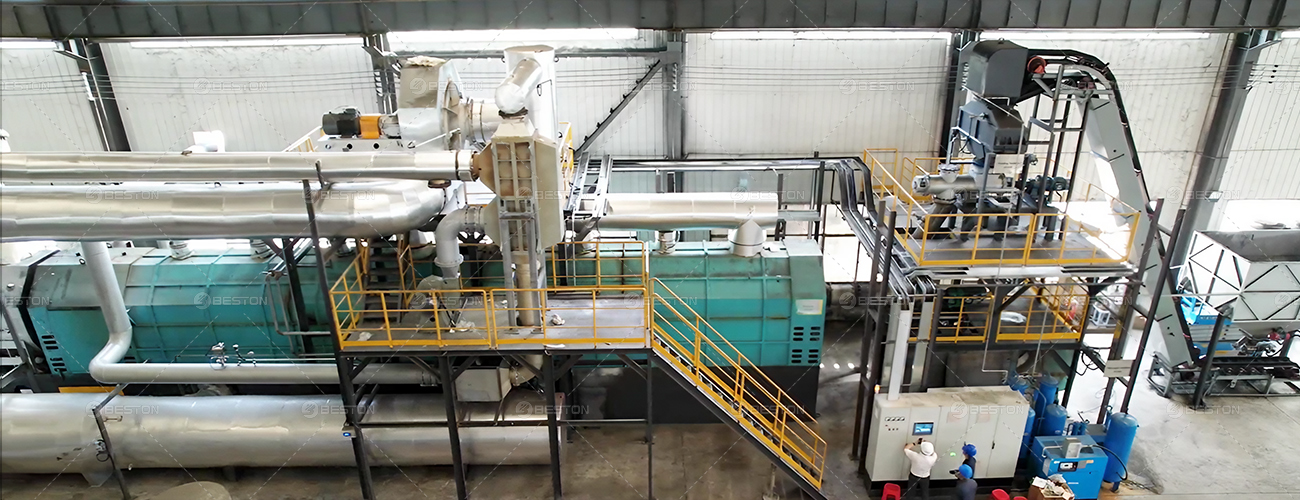
A continuous tire pyrolysis plant requires substantial upfront investment, but the total project cost extends well beyond the reactor itself. The capital structure typically includes process equipment, feedstock preparation, product recovery, emission control, utilities, civil works, installation, and commissioning.
For a continuous facility, the reactor and automated feeding system often represent a major portion of equipment expenditure. However, downstream systems can materially influence the final investment because tire pyrolysis generates multiple product streams that require separate collection and treatment.
A realistic financial assessment should therefore evaluate the complete processing chain rather than using reactor purchase price as the primary benchmark.
Feedstock Preparation Adds Mechanical Costs
Waste tires normally require pretreatment before entering a continuous pyrolysis system.
Depending on plant configuration, preparation may include tire cutting, bead removal, shredding, magnetic separation, and conveying. These processes reduce tire size and improve feeding consistency.
The pyrolysis plant cost of this stage depends on feedstock condition and the desired reactor input size. Whole-tire processing requires more substantial mechanical handling, while pre-shredded tire feedstock can reduce equipment requirements.
Energy consumption and replacement of wear components should also be included in operating cost calculations because shredding equipment experiences significant mechanical loading.

Reactor and Feeding System Are Core Investment Items
The continuous pyrolysis reactor is the central component of the facility.
Its cost is influenced by processing capacity, reactor configuration, material selection, thermal insulation, heating method, automation level, and design pressure.
Continuous feeding equipment is equally important. An unstable feed rate can cause fluctuations in reactor temperature and product yield.
Industrial systems typically incorporate controlled conveyors, sealed feeders, rotary devices, or other mechanisms designed to maintain consistent material input while limiting uncontrolled gas leakage.
The level of automation directly affects both capital expenditure and long-term labor requirements.
Heating and Energy Infrastructure Affect Operating Economics
Tire pyrolysis requires continuous thermal input to maintain the reactor at its target operating temperature.
However, the process itself generates combustible gas that can often be recovered and reused as a heating source. Effective internal gas utilization can substantially reduce dependence on externally purchased fuel.
The overall energy balance depends on feedstock moisture, reactor efficiency, insulation quality, gas composition, and heat recovery performance.
Auxiliary equipment such as burners, gas pipelines, heat exchangers, pumps, and control systems adds to the initial investment but can improve long-term thermal efficiency.
Condensation and Product Recovery Create Additional Costs
Tire pyrolysis generates condensable hydrocarbon vapor that must be cooled and separated into liquid products.
A typical recovery system may include condensers, oil tanks, pumps, cooling equipment, and non-condensable gas handling systems.
The design must account for the temperature range and composition of tire-derived vapor. Poor condensation performance can result in product loss, unstable gas composition, or excessive loading on downstream treatment equipment.
Cooling capacity is another important consideration because continuous operation requires reliable heat removal.
Emission Control Is a Major Cost Component
Environmental control infrastructure can represent a significant portion of total project expenditure.
Tire pyrolysis gas may contain sulfur compounds, volatile organic compounds, particulate matter, and other contaminants. These substances require appropriate treatment before atmospheric release or combustion.
The required system may include dust removal, gas purification, combustion equipment, sulfur control, and monitoring instruments.
The actual configuration depends on local emission regulations, feedstock composition, plant capacity, and whether process gas is internally combusted or otherwise utilized.
Underestimating emission control costs can create substantial financial and regulatory risks during later project stages.
Recovered Carbon and Steel Require Product Handling
A continuous tire pyrolysis facility produces recovered carbon material and steel in addition to pyrolysis oil and combustible gas.
Product collection systems must therefore be integrated into the plant design.
Recovered carbon handling may require cooling, conveying, screening, grinding, and storage. If higher-value applications are targeted, additional upgrading or pelletization equipment may be required.
Steel recovery also involves separation, conveying, and storage systems.
The more refined the final product specification, the greater the potential processing cost.
Labor and Maintenance Shape Recurring Expenses
Continuous operation can reduce labor requirements compared with batch processing because feeding, temperature regulation, product discharge, and other functions can be automated.
Nevertheless, skilled personnel remain necessary for plant supervision, maintenance, quality control, and safety management.
Maintenance represents another recurring cost category. Reactors, conveyors, seals, pumps, shredders, burners, and gas treatment equipment are exposed to thermal, chemical, and mechanical stresses.
Preventive maintenance helps avoid unplanned shutdowns and protects plant utilization.
Utilities and Site Infrastructure Should Not Be Overlooked
Electricity, cooling water, compressed air, lighting, ventilation, and other utilities contribute to the operating cost of a continuous facility.
Site development can also include land preparation, foundations, internal roads, drainage, storage areas, fire protection, electrical infrastructure, and utility connections.
These costs vary considerably by location and should be evaluated during the early feasibility stage rather than treated as secondary expenses.
Revenue Recovery Influences the Overall Economics
The economic performance of continuous tire pyrolysis depends not only on expenditure but also on the value recovered from each product stream.
Pyrolysis oil, recovered carbon material, and steel can generate revenue, while combustible gas can reduce external fuel consumption when reused internally.
Plant utilization is particularly important. A facility operating close to its designed capacity can distribute fixed costs across a larger volume of processed tires, improving unit economics.
Product quality also affects revenue potential. Higher-quality recovered carbon and properly treated pyrolysis oil may access more valuable markets than low-grade products.
Building a Complete Cost Model
The cost structure of a continuous tire pyrolysis plant should be evaluated as an integrated economic system.
Capital expenditure includes the reactor, feeding system, pretreatment equipment, condensation units, emission control, utilities, civil works, installation, and commissioning. Operating expenditure includes electricity, labor, maintenance, feedstock logistics, consumables, and environmental management.
A reliable feasibility model should also account for plant utilization, product yield, product price, maintenance intervals, regulatory requirements, and potential downtime.
When these factors are assessed together, continuous tire pyrolysis can be evaluated on a realistic cost-per-ton basis rather than through equipment price alone. This approach provides a stronger foundation for investment decisions and long-term project planning.
Comments
No comments yet. Be the first to react!