A couch positioned beside a bright window often looks fine for a long time. Then one day you move a cushion and notice the difference. The fabric underneath still holds its color. The fabric exposed to the light has faded badly.
This happens because of two separate forces. Ultraviolet radiation degrades the dyes inside the textile. Steady warmth drains moisture from the fibers until they stiffen. The result is a couch that looks worn and feels weaker than it once did.
Once the damage is clear, you must decide how to respond. You can treat just the affected sections, or you can replace the covering on the entire piece. Each approach has its place, and the right one depends on your circumstances.
What Sun and Heat Do to Fabric
Any repair starts with understanding the problem. Fading caused by sunlight is not a surface issue. UV exposure permanently alters the molecular structure of dyes. No cleaning method can bring that color back.
Heat damage goes further still. When a couch sits in direct sun, the fibers lose the moisture that keeps them supple. Cotton and linen turn dry and prone to cracking. Synthetic blends may harden or deform.
A quick test reveals the extent. Pinch a faded section and pull gently. If it holds, the fibers still have some life. If it tears easily, the damage is structural, not just visual.
The Case for Targeted Repair
A targeted fix addresses only the damaged zones. The rest of the covering stays as it is.
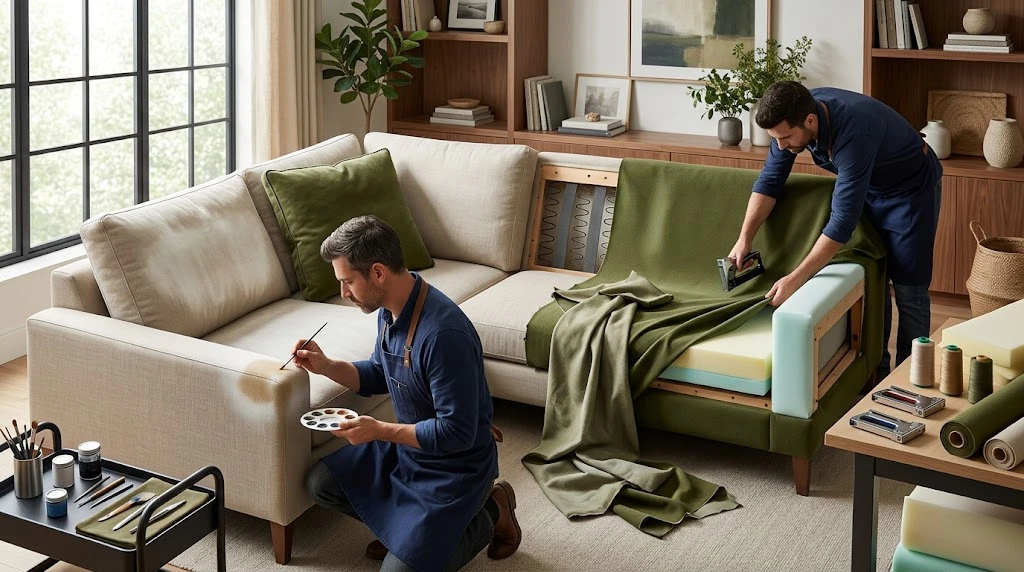
Recoloring is one technique. A technician blends a dye close to the original shade and works it into the faded areas by hand. This suits small, well-defined patches. Grafting is another method. When heat has caused a split, a craftsman can stitch in a matching piece. That material often comes from a hidden spot, such as beneath the frame.
The advantages are practical. The work is faster, and the cost is lower. This route fits furniture where damage is narrow in scope. Perhaps one armrest faded, or a single cushion took most of the exposure.
Boundaries exist, though. Dye matching is difficult on heavily textured fabrics. Patches may be visible up close. If fading spans the whole couch, targeted work looks uneven. When evaluating sofa upholstery services, ask plainly whether your damage is limited enough for this method. A skilled technician will tell you honestly if a spot fix will only resemble a visible mark.
The Case for Complete Replacement
Sofa reupholstery means removing all existing fabric and fitting new material over the entire piece.
The process begins with disassembly. Every layer of old covering comes off. The frame, springs, and padding are then examined. Worn foam is replaced. Loose joints are re-glued and secured. New fabric is stretched across the whole structure.
This method removes sun damage completely. You get a consistent color and entirely new material.
It fits situations where damage is widespread. If the back, arms, and seats all show fading, replacement is the practical answer. It is also the right call when heat has left the fabric brittle. Dye cannot restore strength to fibers that are already failing.
Expect higher costs and a longer timeline. What you get is essentially a renewed couch. The frame, often the costliest part to manufacture, is preserved.
Making the Decision
Three factors should shape your choice: the reach of the damage, the condition of the fibers, and your available budget.
Begin with scope. Step back and view the couch as a whole. Is the fading confined to one region? Does it cover more than about a fifth of the surface? Broad damage rules out a localized approach. Dyeing a large area seldom produces a clean result.
Then assess the material. Grip a faded section and tug lightly. Does it flex, or does it feel rigid? Is there a faint tearing sound? Brittle fabric is nearing the end of its usable life. Surface treatment cannot correct structural decline. That situation calls for sofa reupholstery.
Finally, consider cost relative to the piece itself. A localized fix is cheaper upfront. For an inexpensive, factory-made couch, extensive restoration may not justify the expense. For a solid frame or a piece with personal meaning, reupholstering protects something worth keeping.
A middle path sometimes works. Seat cushions can be replaced while the backrests receive dye treatment. This is viable when the backrests remain strong. It trims cost while renewing the areas that take the most daily wear.
Preventing a Repeat
Once the repair is done, prevention takes priority. Sun-related deterioration is largely avoidable. Managing light exposure is the central task.
UV-filtering window film and sheer curtains both help. Film is see-through, so daylight still enters, but the damaging rays are blocked at the glass.
Monthly cushion rotation is another simple habit. It keeps one side from facing the light constantly. Wear spreads more evenly as a result.
If a room becomes very hot in the afternoon, think about moving the couch. Even a modest distance from the window can reduce the temperature the fabric reaches.
Closing Thoughts
Fabric damaged by sun or heat is discouraging to discover. It makes a good couch look tired ahead of schedule. Still, you are not without options.
When the damage is narrow and the material still has strength, a targeted repair can resolve the problem. When fading is extensive and the fabric feels fragile, complete replacement is the wiser choice.
Study your couch carefully. Test the fibers. Determine what the piece means to you. Then speak with a professional, explain what you have observed, and request an assessment. An experienced craftsman will guide you toward the solution that genuinely suits your furniture.
Comments
No comments yet. Be the first to react!