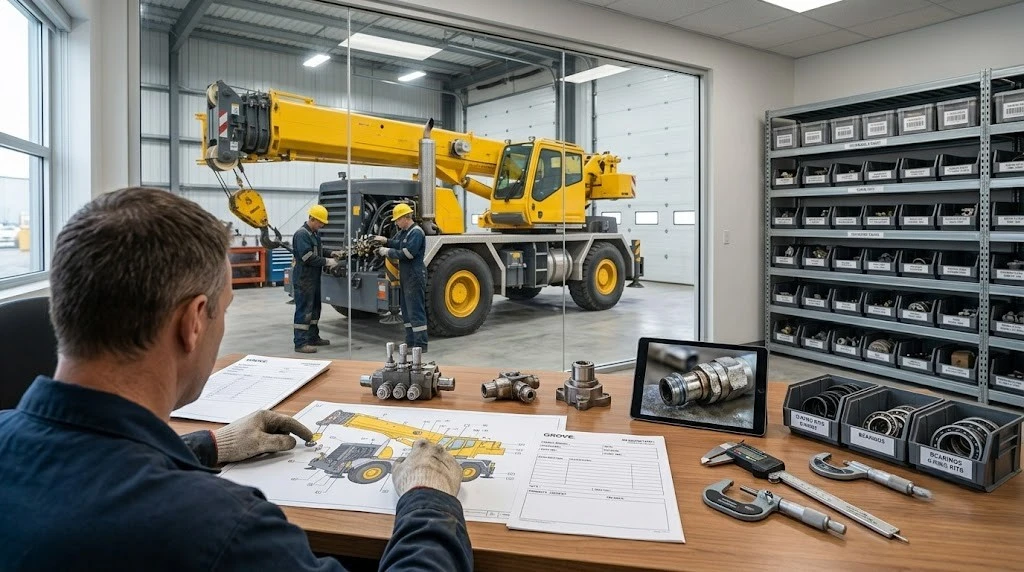
A crane parked on a job site because of a missing or incorrect component represents a failure of process, not just bad luck. Your maintenance team wants to fix things quickly, and they usually can — when they have the right part in hand. But ordering the wrong item because someone misread a catalog or transposed a number creates a chain of delays that compounds the original problem.
Training your crew to identify components with precision and navigate the ordering process confidently is one of the highest-leverage investments you can make. This guide explains how to build that capability across your maintenance operation from the ground up.
Begin with the Machine, Not the Manual
A catalog makes far more sense when the reader already understands the physical equipment it describes. Start every training cycle beside an actual crane where systems are visible and their relationships are obvious.
Walk through the machine as a group. Begin at the power source — the engine and hydraulic pump assembly. Trace fluid lines from the reservoir through the valve bank to each actuator. Move to the electrical harness and identify the major connector blocks. Finally, examine the boom structure, pointing out how sections nest, pin together, and extend.
This exercise creates a mental framework that shapes everything the technician does later. When someone has physically traced the hydraulic circuit responsible for boom hoist function, they approach the catalog search for Grove crane parts with a clear idea of which assembly group to target. They are not browsing randomly — they are navigating with purpose.
Develop Manual Reading as a Practical Discipline
Parts catalogs contain an enormous amount of information packed into dense pages of diagrams and lists. Simply handing one to a technician and expecting fluent use invites errors that cascade into wrong orders.
Gather the team and open the manual for a specific machine. Start with the most fundamental skill: confirming you have the correct catalog for the correct crane. Show them where to find the model and serial number on the physical unit, then demonstrate how to match those details to the catalog’s identification page. Stress that even visually similar cranes from the same manufacturer can have substantially different internal parts.
Then teach the manual’s internal logic. Walk through the table of contents and assembly groupings. Open an exploded-view drawing and explain how each leader line connects a numbered callout to its entry in the parts list. Pay close attention to the boundary between assembly numbers and individual component numbers.
Misunderstanding that boundary leads to some of the most costly mistakes in the ordering process. A technician who selects a complete hydraulic pump assembly when only an internal bearing and seal kit are needed has significantly overspent and still has not completed the repair.
Create Shop-Based Identification Drills
The ability to connect what a catalog shows with what a part looks like in real life requires physical practice. Without it, even well-studied technicians struggle at the moment of identification.
Collect decommissioned Grove crane parts from your salvage inventory. Hydraulic fittings, a worn swing gear section, electrical solenoids, brake pads, and sections of steel pin all serve as effective training materials. Arrange them on a table and ask each person to identify every item using only the catalog.
Teach the team to search for manufacturer markings. Numbers are typically stamped into flat metal surfaces, cast into iron housings, or attached via tags on flexible components. Explain that years of use frequently obscure these marks. When direct identification is not possible, the fallback technique involves precise measurement with calipers and comparison against catalog specifications.
One drill that consistently produces strong results: hand a technician a hydraulic motor removed from a scrapped machine. Ask them to locate the correct rebuild kit in the catalog without any assistance. Allow several minutes of independent navigation before offering guidance. The moment of struggle followed by resolution creates a durable learning experience that no amount of passive listening can replicate.
Standardize How Orders Get Placed
Identifying the correct part is only half the equation. Ensuring the order is placed accurately — and arrives at your shop as the right item — requires a disciplined, documented workflow.
Design a purchase requisition form that every parts request must follow. Each form should capture the crane model, the machine serial number, the catalog component number, a written description, and the quantity needed. No field should be treated as optional.
Set a firm policy against informal ordering. Verbal requests and scribbled notes on scrap paper should never result in a shipment. Every submission to a crane parts supplier must contain catalog-verified details that enable the vendor to fulfill the request without ambiguity or follow-up questions.
Add a verification checkpoint to the workflow. The technician who identified the part reviews their numbers against the catalog one more time. A supervisor then confirms the information before the order is transmitted. This two-step review eliminates the most common transcription and selection errors before they become expensive problems.
Teach Your Crew to Interact Effectively with Vendors
Regular communication with a crane parts supplier is an unavoidable part of fleet maintenance. How well your team handles those conversations affects turnaround times, order accuracy, and overall efficiency.
Start by making introductions. Connect your lead technicians with the vendor’s primary account representative. Having an established relationship removes friction when urgent orders need to move quickly.
Before any vendor interaction, the technician should prepare a complete set of details: the machine serial number, the verified component number, and the catalog page where they found the reference. If any doubt remains about which part is correct, a photograph of the physical item sent alongside the catalog excerpt usually settles the question without delay.
Coach your team on being direct about requirements. Suppliers handle high volumes of daily requests, and clear submissions get processed faster. If the part is needed by a specific deadline, state that explicitly rather than leaving it to the vendor’s default shipping schedule.
Navigate Discontinued and Superseded Components Confidently
Product lines evolve over decades of manufacturing. Some machines in your fleet will inevitably require parts that have been revised, superseded, or removed from the catalog entirely.
Train your team to handle these situations without hesitation. When a catalog number returns as unavailable, it most likely means a newer version now exists under a different reference. The updated component may appear different from what the manual illustrates while offering improved durability.
Some updated parts require minor modifications to older machines for proper installation. Your technicians should view these scenarios as routine, not alarming. The ability to navigate superseded references confidently separates experienced mechanics from novices.
If a component has been fully discontinued, a resourceful crane parts supplier may still be able to source aftermarket equivalents or arrange remanufacturing of the original. Your team needs to know these options exist and should pursue them before concluding that a machine has reached the end of its serviceable life.
Test Competency Through Simulated Situations
The gap between understanding a process and executing it when a real machine is down can be significant. Regular simulations bridge that gap and build the composure your team needs under pressure.
Create a realistic scenario. A crane on a remote site has suffered a complete failure in its boom hoist circuit. The machine is immobile. Give each technician a defined time window to diagnose the probable cause, locate the correct Grove crane parts in the catalog, and prepare a complete purchase requisition with all necessary details.
Debrief the exercise as a group. Evaluate whether they selected the appropriate part, completed every field on the requisition form, addressed delivery urgency, and inquired about core charges for any rebuildable components.
These drills accomplish two goals simultaneously. They reveal specific knowledge gaps before those gaps create real problems on a job site. And they give technicians practice maintaining focus and accuracy under the kind of pressure they will face during actual equipment failures.
Ensure Manuals and Digital Resources Stay Accessible
A training investment loses value when technicians cannot reach the reference materials they were taught to use. Parts catalogs and digital resources need to be available wherever work happens.
Keep printed copies in the workshop, the maintenance office, and any field service vehicles. Distribute digital versions through a shared network folder or load them onto tablets and smartphones for portable access.
When a mechanic is troubleshooting beneath a crane in difficult field conditions, the ability to access the correct manual page on a handheld device can save hours of idle time. Organize your digital files by model and serial number so that navigating to the right reference takes moments, not minutes.
Build a Culture of Continuous Learning
Parts identification and ordering proficiency does not develop from a single training event. It requires regular practice, process refinement, and a willingness to learn from every mistake.
When a wrong component arrives, resist the urge to place blame. Instead, trace the process. Was the catalog page misread? Was a digit entered incorrectly? Was the vendor given incomplete details? Identify the root cause and correct it.
Document those corrections and incorporate them into future training sessions. Every lesson learned becomes part of a shared knowledge base that elevates the entire team’s performance.
When your maintenance crew can identify and source Grove crane parts with consistency and confidence, the results are immediate and measurable. Equipment returns to service faster, budgets remain under control, and your technicians carry the professional assurance that comes from genuinely mastering the details of their work.
Comments
No comments yet. Be the first to react!