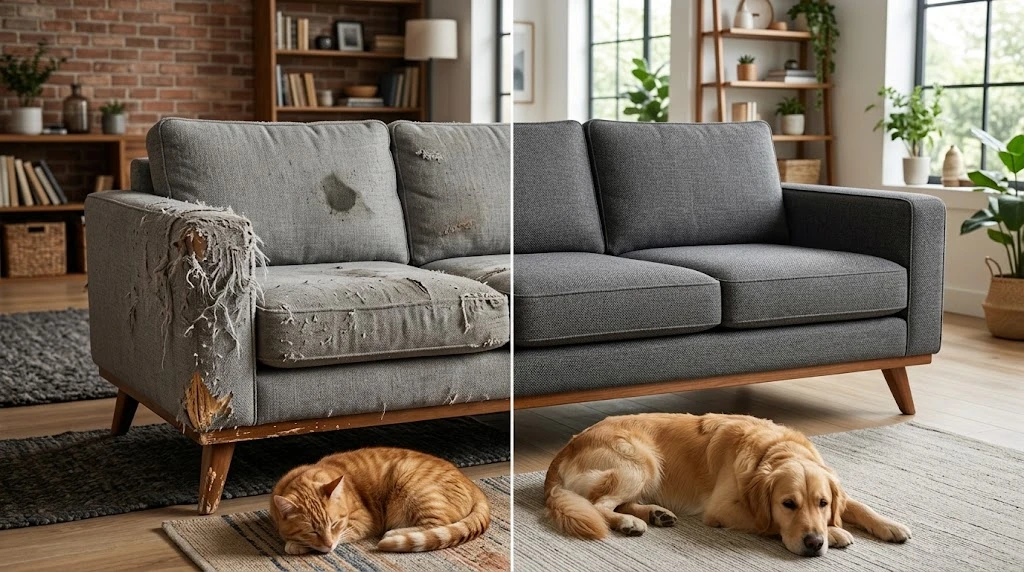
The living room sofa tells a story in your household. It records every nap your dog has taken, every corner your cat has sharpened its claws on, and every accident that soaked through to the padding. Over time, what started as minor wear becomes a piece of furniture that looks exhausted. Fabric shreds, wood splinters, and odors linger no matter how often you clean.
Most people assume replacement is the answer. But discarding a structurally sound couch because of surface and mid-layer damage is wasteful. Sofa reupholstery restores furniture by addressing every compromised layer — not just the visible fabric but the padding, the frame, and the source of embedded smells.
What Drives Pets to Damage Furniture
Understanding why pets damage things makes the repair process more intuitive. Cats scratch for biological reasons. Their claws grow in layers, and scratching removes the dead outer sheath. The action also provides exercise for their forelimbs and deposits scent from glands in their paws onto the surface.
Dogs chew in response to emotional and developmental triggers. Anxiety, boredom, and teething all channel energy toward available objects. Your sofa arm is simply the nearest target.
These behaviors create layered damage. Surface fabric tears first. Beneath that, foam padding gets punctured and compressed. Deeper still, wooden supports crack under the force of sustained chewing. Liquids from vomit or urine penetrate all three layers, carrying odor molecules that bond to porous materials. The cumulative effect is a piece of furniture failing on multiple structural levels simultaneously.
Repairing Fabric Destroyed by Cat Claws
The armrest and front corners of any sofa attract the most scratching. Manufacturers pull fabric tight across those surfaces during assembly, and that tension is precisely what cats find satisfying. It does not take long for repeated scratching to reduce the material to a tattered shell.
Repairing this damage demands a complete fabric replacement rather than a spot fix. The upholsterer begins by extracting every staple and removing the shredded material down to the padding layer. Skipping this step and patching over the damage simply creates weak points that fail quickly.
Foam inspection follows. Deep gouges where claws punched through get cut out and filled with matching-density padding. Professional sofa upholstery services at this juncture allow you to select a replacement fabric with a tighter weave that resists claw penetration. Fresh material gets positioned, stretched evenly across the surface, and secured with industrial staples along the frame’s underside. The rebuilt armrest is structurally sound and far more resistant to future scratching than the original.
Rebuilding Structural Damage from Chewing
Canine chewing produces a category of damage that fabric alone cannot fix. Dogs target hard surfaces — legs, armrest bases, and exposed frame edges. The result is splintered wood, compromised joints, and weakened structural connections.
This type of repair requires attention to the sofa’s skeleton. The upholsterer examines every joint and support member for cracks, splits, or looseness. Surface-level damage gets smoothed with wood filler. Where chewing has gone deep, the solution involves cutting out compromised sections and securing replacement wood with glue and screws.
With the frame stabilized, fresh batting and foam restore the original contours of the damaged area. A new fabric panel is cut to match the dimensions of the affected section, sewn with precision, and fitted to blend with the surrounding upholstery. Even severe chewing damage can be reversed when the repair addresses the structural layer before moving to cosmetics.
Tackling Odors at Their Source
Lingering smell is often what pushes homeowners toward buying a new couch. Surface cleaning products address the outermost layer of contamination, but they cannot reach materials deeper inside the cushion. Urine in particular travels through fabric and foam, settling into the wooden deck beneath.
As moisture evaporates, it leaves behind crystallized compounds. Heat and humidity reactivate these crystals, sending the odor back into the room. The problem is self-perpetuating as long as the contaminated materials remain inside the sofa.
Sofa reupholstery eliminates this cycle by physically removing the source. During the teardown phase, the upholsterer separates every component. Saturated foam gets discarded — it cannot be adequately cleaned once contamination has penetrated its structure.
The exposed wood receives targeted treatment. An enzyme solution breaks down organic residue, and a primer seals the surface to trap any lingering molecules. New foam is installed with a moisture-resistant liner between it and the frame. Every contaminated layer is replaced, which means the odor does not return because the material that harbored it no longer exists.
Making Smart Fabric Choices for Pet Homes
Once damage is repaired, the goal shifts to prevention. The fabric chosen during the reupholstery process determines how well the sofa withstands ongoing contact with animals.
Open-weave textiles are the most vulnerable. Linen, tweed, and bouclé all feature thread patterns with enough space for claws to hook and pull. A single caught claw can unravel a run that extends across an entire panel.
Densely woven fabrics handle pet traffic far more effectively. Canvas and denim resist punctures and recover well from surface abrasion. Microfiber is particularly practical — its tight surface does not trap hair, and stains wipe away with minimal effort.
Leather handles odor well and sheds hair instantly. It is not immune to puncture damage from persistent cats, however. For households with multiple pets or particularly active animals, engineered performance fabrics offer the strongest combination of durability and easy maintenance. These materials are manufactured specifically to repel liquids, resist staining, and tolerate repeated physical contact. Quality sofa upholstery services include expert guidance on selecting among these options. A skilled upholsterer will evaluate your specific pet situation and recommend fabrics that match the demands of your household.
How the Restoration Unfolds
Knowing the sequence of work helps set expectations and evaluate the scope of what you are paying for.
Assessment opens the project. The team examines the frame, the suspension, and the existing covering. They identify every issue and present an estimate reflecting the full scope of labor and materials.
Teardown comes next. Thousands of staples are extracted by hand. Old fabric, batting, and padding are stripped away layer by layer. This phase is physically demanding and messy, but it reveals the true condition of the frame and internal components.
Structural repair constitutes the bulk of the timeline. Worn springs are replaced. Loose joints are re-glued and reinforced with fasteners. Damaged wood is patched, and contaminated materials are either treated or removed. This is the phase where sofa reupholstery delivers its greatest value — restoring the internal integrity that makes the piece functional rather than merely presentable.
Cutting and sewing follow. The upholsterer traces the original fabric panels onto new material, cuts each piece to exact specifications, and assembles them on industrial sewing equipment designed for heavy upholstery fabrics.
Installation closes the project. The new cover is pulled taut and stapled in place. Finishing details like piping, welt cords, or button tufting are applied. Cushions are restuffed and returned to their positions. The couch re-enters your living room as a structurally rebuilt, freshly covered piece ready for years of continued use.
Evaluating Whether Reupholstery Makes Financial Sense
Not every damaged sofa justifies the cost. Sofa reupholstery involves skilled labor across multiple trades — teardown, carpentry, foam work, sewing, and finishing. The decision should weigh the investment against the quality and sentimental value of the piece.
Construction quality is the primary consideration. A sofa built on a kiln-dried hardwood frame has a skeleton designed to last decades. The cost of rebuilding around that skeleton is reasonable when the foundation is strong. Furniture constructed from particle board or lightweight composites does not respond well to the disassembly and rebuilding process.
Comfort and fit matter too. If the dimensions of your sofa suit your space and the seat depth matches your preferences, finding an exact replacement can be surprisingly difficult. The couch you already own may offer qualities that new options at comparable prices do not.
There is also an environmental dimension. A full-size sofa occupies significant landfill volume. Extending its useful life through skilled restoration conserves raw materials and reduces the manufacturing energy required to produce a replacement. This reasoning applies especially when the existing frame is structurally sound beneath the surface damage.
Closing Thoughts
Pets and furniture inevitably collide. Cats leave shredded fabric on armrests. Dogs leave splintered wood on legs and frame edges. Odors settle into foam and resist every attempt at surface cleaning. None of these problems, however, require you to part with furniture that still has solid bones. A comprehensive reupholstery process addresses each layer of damage — rebuilding the frame, replacing saturated padding, and finishing the piece in a material chosen for durability. The result is furniture that serves both your household and your pets for years to come.
Comments
No comments yet. Be the first to react!